Trusted UK Casinos: Licensing and Safety Checks
 Available in GB

UK licensing provides a legal threshold, while verification, payment terms, enforcement and crypto claims need separate scrutiny.
Table of Contents
- What UK Licensing Establishes About Online Casinos
- Real-Money Play: Verification, Deposits and Withdrawals
- How to Check a Casino Site’s Regulatory Status
- Assessing Trust Claims Without a Ranking
- What Licensing Can—and Cannot—Show About Crypto Casinos
- Enforcement and Jurisdiction: Why a UK Casino Claim Needs Context
- Casino Reviews, Free Spins and Bonus Conditions
- Casino Apps and Account-Level Safeguards
- Bitcoin and Dogecoin Casinos: The Evidence Gap
What UK Licensing Establishes About Online Casinos
A claim that an online casino is trusted has a more concrete starting point than its presentation or reputation: whether the service is authorised to offer remote gambling in the market it serves. In Great Britain, a business providing online gambling facilities to consumers must hold the relevant UK Gambling Commission licence. This requirement applies whether the business is based in Britain or elsewhere. A company’s overseas location does not remove the licensing obligation when it offers gambling to consumers in the British market.
The UK Gambling Commission (UKGC) is the regulator responsible for remote gambling offered to consumers in Great Britain. Its licensing role establishes the legal basis on which an online casino may provide gambling services there. A UKGC Licence is therefore a regulatory threshold, not a decorative endorsement. Without the required authorisation, an operator is outside the framework that permits remote gambling to be offered lawfully to consumers in Great Britain.
The scope of the framework depends on the service and the market, rather than on the operator’s branding or headquarters. An online casino may use a company registered abroad, but that fact alone does not determine whether it may serve British consumers. The relevant point is whether it offers remote gambling facilities into Great Britain; if it does, the licensing requirement applies. This is why references to a company’s country of incorporation should not be treated as a substitute for understanding the applicable regulatory regime.
Choosing a trusted UK casino means checking the information available before deciding where to play. This list gives a concise reference point based on the stated payout-speed details.
1. x3bet
Payout speed: 1-3 business days x3bet has a stated payout speed of 1–3 business days.
2. NightLuck
Payout speed: 1-3 business days NightLuck lists payouts as taking 1–3 business days.
3. BeOnBet
Payout speed: 1-3 business days BeOnBet’s stated payout speed is 1–3 business days.
4. WinBeast
Payout speed: 1-3 business days WinBeast has a listed payout speed of 1–3 business days.
5. Revery Play
Payout speed: 1-3 business days Revery Play states a payout speed of 1–3 business days.
6. Amunbet
Payout speed: 1-3 business days Amunbet lists a 1–3 business day payout speed.
7. Zombillion
Payout speed: 1-3 business days Zombillion’s stated payout speed is 1–3 business days.
8. Jetsetspins
Payout speed: 1-3 business days Jetsetspins gives a payout speed of 1–3 business days.
9. Dieselwin
Payout speed: 1-3 business days Dieselwin has a stated payout speed of 1–3 business days.
10. NightWin
Payout speed: 1-3 business days NightWin lists payouts as taking 1–3 business days.
The Gambling Act 2005 provides the statutory framework for gambling in England, Wales and Scotland. Within that framework, a casino is defined by the arrangement through which people are given the opportunity to take part in one or more casino games. The definition focuses on the gambling opportunity being provided, rather than whether the service resembles a traditional casino building. Online casino services consequently fall within the broader regulatory question of how gambling is offered to consumers remotely.
Licensing also gives a more precise meaning to descriptions such as “trusted UK online casino”. The phrase can imply several different things, including lawful operation, dependable payments, fair games or good customer service. The licence requirement establishes a particular point: a remote gambling business serving Great Britain must be authorised by the UKGC. It does not, by itself, prove every wider claim implied by “trusted”, nor does the word supply evidence about an operator’s comparative quality.
That distinction matters because regulatory status and consumer judgement are related but not interchangeable. A licence places an operator within the relevant regulatory framework; it is not a guarantee that every aspect of the service will meet an individual customer’s expectations. Conversely, a polished website or familiar brand name cannot replace the authorisation required for remote gambling in Great Britain. The legal threshold is specific, even when marketing language is broad.
Non-UKGC-Licensed Casinos: Rules and Risks
The requirement is not confined to businesses that describe themselves as casinos. It applies to remote gambling businesses offering facilities to consumers in Great Britain. The casino label may help describe the games or service, but the central regulatory issue is the provision of remote gambling to the British market. In this respect, licensing is a matter of jurisdiction and activity, not merely a category chosen in an operator’s advertising.
The framework also helps separate a domestic-facing service from a general claim of international availability. A site may be accessible online from different places, but technical access does not itself establish that the operator is authorised to offer gambling in Great Britain. The relevant basis is the licence required for the market in which the service is provided. This is why broad statements about an online casino being “available in the UK” should not be read as proof of UKGC authorisation.
For a person assessing a trusted casino online in the UK, licensing is therefore a necessary foundation for lawful provision, but not a complete measure of trust. It identifies the regulator whose framework applies and the condition an operator must meet to serve consumers in Great Britain. Questions about the status of a particular business, the protections attached to an account, or the quality of its service require separate consideration. The licensing regime establishes the boundary of authorised remote gambling; it does not turn a general trust claim into a verified conclusion.
Attention: A UKGC licence is a regulatory threshold and does not, by itself, prove every claim of trust or guarantee that a service will meet every individual customer’s expectations.
Real-Money Play: Verification, Deposits and Withdrawals
Real-money casino access involves more than opening an account and choosing a payment method. Identity checks come first: under UK rules, an operator must verify a customer before allowing a deposit or gambling. This places verification at the start of the account process, rather than treating it solely as a step that might arise when winnings are requested.
Verification before depositing or playing
Identity verification commonly involves providing an image of a passport or driving licence and a recent utility bill. These documents serve different purposes: the identity document supports confirmation of who holds the account, while the bill can help establish an address. The requested material may need to be submitted through the operator’s account process before access to real-money play is available.
That sequence matters when assessing how a casino handles account access. A site that permits a deposit or a wager before the required checks have taken place would not follow the stated UK requirement. Verification is therefore part of the conditions for using a real-money account, not merely an administrative detail that can be postponed indefinitely.
The documents themselves do not determine how quickly an account will be cleared. Submission and review are distinct steps, and a request for an image does not, by itself, establish that the operator has completed its checks. Account access depends on verification taking place before depositing or playing. The practical point is that payment access and gambling access are tied to the completion of the required identity checks.
UK Casinos Without a UKGC Licence: Rules and Risks · Anjouan Casino Licence in the UK: What It Means
The same distinction helps explain why a deposit method should not be treated as proof that an account has been verified. A payment may be available within an account’s cashier, but the UK requirement still places identity verification before a customer can deposit or play. Payment availability and permission to use the account for gambling are separate matters.
Deposits and withdrawals are separate stages
Once verification is complete, depositing and withdrawing remain different account functions. Deposit and withdrawal availability are separate: a method shown for adding funds does not, on that basis alone, establish that it can also be used to receive a withdrawal. The payment options and conditions for each transaction need to be considered independently.
This distinction is relevant to real-money play because the ability to fund an account does not describe the full movement of money through it. A deposit enters the gambling account; a withdrawal is a separate request to transfer funds out. The account may therefore involve different stages and checks, even when both transactions relate to the same customer.
Identity checks may also arise around a withdrawal. A first withdrawal can involve document review in addition to the checks completed earlier in the account process. One specialist casino review reports that first-time withdrawals may take an additional 12–24 hours for document checks. That reported interval should be understood as a particular review’s account of the process, not as a universal processing commitment or a fixed timetable for every operator.
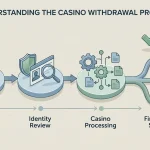
Real-Money Account Sequence
Step 1: Identity Verification
Provide a passport or driving licence and a recent utility bill to confirm identity and address before depositing or playing.
Step 2: Funding the Account
Complete a deposit using an available payment method once identity checks are cleared.
Step 3: Withdrawal Request
Request a transfer of funds out of the account, which may involve additional document checks for the first transaction.
The distinction between an operator’s review and the movement of funds is important. A withdrawal request can involve checks before it is processed, while the time required for the payment itself is a separate matter. The reported document-check interval does not establish when funds will arrive, nor does it describe every payment method or account. It concerns an additional check associated with a first withdrawal.
A request for documents at this stage does not necessarily mean that the earlier verification did not occur. It indicates that account checks and withdrawal processing can involve more than one point of review. Conversely, completing an initial identity check does not establish that every later transaction will be processed without further questions. The relevant conditions depend on the account and the transaction being handled.
Reading the account process as a whole
For real-money use, the sequence is best understood as a set of connected but distinct stages: identity verification before depositing or playing, a deposit into the account, and a separate withdrawal request when funds are to be transferred out. Document checks can occur at the initial verification stage and may also be relevant to a first withdrawal.
This sequence offers a clearer basis for assessing account access than a general claim that a site is trusted. The key process questions concern when verification occurs, what identity documents are requested, and whether withdrawal handling is described separately from deposits.
Gibraltar Casino Licences in the UK: What They Mean · Curacao Casino Licence in the UK: Rules and Limits
A casino’s presentation of payment options should therefore be read in the context of account requirements. Depositing is not available before the required identity verification, and a listed deposit route does not automatically establish a corresponding withdrawal route. Where a first withdrawal requires document checks, the review time is distinct from the subsequent payment process. These distinctions clarify what real-money account access entails without treating verification, deposits and withdrawals as one interchangeable step.
How to Check a Casino Site’s Regulatory Status
A casino’s regulatory status is best assessed by matching the service presented to customers with the relevant entry in the UK Gambling Commission’s public register. A brand name alone is not enough: the registered operator may use a different legal name, and a site may be associated with an operator through a white-label arrangement. The important question is whether the business providing the gambling facilities is covered by a current UKGC operating licence for the relevant activity.
A practical check begins with the operator details shown on the casino’s website, usually in its terms, licensing information or footer. The legal entity and any stated licence number can then be compared with the Commission’s register. The register can also be searched by a domain, which helps establish whether the particular website is connected to the listed operator. A brand, company or domain that cannot be matched should not be treated as evidence of licensed status.
Do
- Match the legal entity and licence number with the UKGC public register
- Search the register by domain to verify the specific website
- Check the current status of the operator on the date of use
Don’t
- Rely on a brand name or logo alone to confirm licensed status
- Treat a claim of being “UK licensed” as proof without verification
- Assume a parent company’s entry covers every associated brand
The comparison should be exact enough to distinguish similarly named businesses and domains. A familiar logo or a claim that a site is “UK licensed” does not confirm that the specific service is covered. Nor does an entry for a parent company necessarily establish that every brand using its name is included. Where the register identifies a domain as linked to an operator, that relationship is more informative than a general statement on a promotional page. The register records regulatory information, but it does not amount to an endorsement of the site or its commercial terms.
A check also needs to be current. A register entry describes the position recorded at the time it is consulted; corporate arrangements and domain relationships can change. The date of a check therefore matters, particularly where a review or comparison page may have been written earlier. If the operator’s own information and the register appear inconsistent, the discrepancy is a reason to withhold a conclusion rather than assume that one version is correct.
Regulatory status is only one part of assessing a casino account. UKGC-licensed remote operators serving Great Britain must participate in GAMSTOP, and participation became compulsory on 31 March 2020. This provides a meaningful check on whether a core self-exclusion safeguard is part of the regulated service. It does not establish that every account-level tool is equally easy to find or use, so the relevant controls should also be visible within the account interface.
USA Casinos for UK Players: Licensing and Risks
Financial-limit controls are another practical indicator of how protections operate. Remote operators must prompt new customers to set a financial limit before their first deposit and provide accessible controls for managing limits. A reduction takes effect immediately, whereas an increase is subject to a cooling-off delay. These details matter because a policy statement alone does not show how a control works in practice: the account should make the available limit settings and their consequences clear.
UKGC licensees must also provide responsible-gambling tools, including self-exclusion, as well as an internal complaints process and access to an approved Alternative Dispute Resolution service. These protections are distinct from the licence-register match. The register helps establish whether an operator is within the Commission’s regulatory system; the account and complaints information indicate what routes are available if a problem arises. Neither should be substituted for the other.
Claims about trusted casino sites, slots or payment options should therefore be kept separate from the regulatory check. A licence does not demonstrate that a particular bonus is suitable, that a payment method can be used for both deposits and withdrawals, or that a review’s description of a site is impartial. Those claims require their own scrutiny. For a casino bonus, the applicable terms determine the conditions; the register cannot validate promotional wording.
Review websites can help identify names and claims to investigate, but their descriptions are not a substitute for the Commission’s record. A page may repeat an operator’s own statement, refer to a different domain or fail to reflect a later change. Its value lies in pointing towards details that can be checked independently, not in conferring regulatory status.
A reliable assessment thus rests on several separate checks: a current register match for the operator and domain, visible account-level safeguards, and clear routes for complaints. Where any link in that chain is uncertain, the status of the specific site remains unestablished.
Regulatory Assessment
- Verify the operator and domain via the UKGC public register
- Confirm participation in GAMSTOP and the presence of financial-limit controls
- Ensure access to an internal complaints process and an approved ADR service
- Treat licensing as a foundation for lawful provision rather than a complete measure of trust
Assessing Trust Claims Without a Ranking
Labels such as “best” and “most trusted” compress several different judgements into a single phrase. They may refer to regulatory standing, the clarity of account terms, customer support, or safeguards for people who gamble. Without a stated measure and evidence for it, the label is an opinion rather than a conclusion that can be tested. A ranking can therefore look precise while leaving unclear what was assessed and how competing criteria were weighted.
A more useful assessment separates verifiable protections from promotional language. Relevant evidence includes whether an operator provides account-level tools for managing gambling, has an internal complaints process, and gives access to an approved Alternative Dispute Resolution service. These features do not establish that every customer will have a good experience, but they are more concrete than an unsupported claim of trustworthiness. The presence of a safeguard also does not show how effectively it works in an individual case.
Communications about offers provide another indicator of how clearly a service treats customer choice. Casinos must give customers greater control over the types of promotions they receive and the channels used to deliver them. A claim centred on customer care is therefore more meaningful when it can be related to clear choices and controls, rather than simply repeated in advertising. Promotion wording alone cannot demonstrate the quality of a casino’s wider protections.
Online casinos with no sister sites in the UK
The phrase “trusted casino” can also blur distinctions between the operator and the games it makes available. Confidence in an operator concerns matters such as account safeguards, complaints and communications. Confidence in a particular game would require evidence about that game, which is a separate question. A casino’s general reputation cannot, by itself, establish that every game has the same characteristics or that every player will have the same experience.
Comparisons should disclose their limits. A list described as the best trusted casinos in the UK implies that the operators were assessed against consistent criteria and that the evidence supports their relative positions. If the criteria are unclear, or if promotional claims are treated as proof, the ordering conveys more certainty than the underlying assessment warrants. The same caution applies to claims about trusted casino games: the wording does not identify what “trusted” means or what evidence supports it.
Trust is not a single measurable property. It is better treated as a set of narrower questions about protections, transparency and accountability, with conclusions confined to the evidence for each. For support with gambling-related harm, the National Gambling Helpline is available at any time on 0808 8020 133. That service is a support resource, not evidence for or against a casino’s claims.
What Licensing Can—and Cannot—Show About Crypto Casinos
A UKGC Licence addresses the regulatory status of gambling offered to customers in Great Britain. The operator’s country of establishment does not remove that requirement: a business based abroad still needs the relevant licence if it provides remote gambling facilities to people in Great Britain. The presence of cryptocurrency in a casino’s branding or payment claims does not, by itself, alter this territorial rule.
A UKGC Licence confirms the legality of the remote gambling service in Great Britain; it is not evidence of specific cryptocurrency acceptance or payment processing methods.
That distinction matters when assessing claims about trusted crypto casinos in the UK. A licence is relevant to whether an operator may lawfully offer remote gambling in this market; it is not evidence that the operator accepts a particular cryptocurrency, processes crypto payments in a particular way, or makes those options available to British customers. Those are separate questions about the service and its payment arrangements.
Nor does the word “crypto” establish that a casino is available to UK customers. A site may describe itself as a crypto casino while its relationship with the British market remains unclear. The label alone cannot show whether the operator is offering gambling facilities to people in Great Britain, or whether the relevant UKGC Licence applies to that service. A claim of being among the most trusted crypto casinos therefore needs more than a general reference to cryptocurrency or an operator’s location.
The same care applies in reverse. A UKGC Licence should not be treated as proof that an operator supports cryptocurrency. Regulatory status and payment acceptance are distinct attributes, and one cannot be inferred from the other. Statements about coin choices, deposits, conversions, withdrawals or transaction handling require evidence specific to those arrangements; a licence claim does not supply those details.
Accordingly, “trusted” is not a conclusion that follows simply from the use of digital currency, nor from a casino’s name or promotional description. For a casino claiming to serve Great Britain, the relevant licensing question concerns the remote gambling service offered to customers there, irrespective of where the business is based. The crypto question concerns what payment facilities are actually offered and to whom. Conflating these points can make a site appear more clearly established than the information presented warrants.
Casino Sites Not Registered with GamStop in the UK
A careful assessment of a trusted crypto casino in the UK should therefore keep these claims separate. Licensing can indicate whether the operator is within the British regulatory requirement for remote gambling; it cannot, on its own, settle payment-specific questions or substantiate a broad ranking of trustworthiness. Claims about crypto access need to be considered on their own terms rather than treated as a consequence of licensing. Conversely, a description of crypto payment options cannot substitute for the regulatory status required when remote gambling is offered to consumers in Great Britain.
Enforcement and Jurisdiction: Why a UK Casino Claim Needs Context
A casino’s connection to the British market and the scope of a regulator’s authority are related but distinct matters. The Gambling Commission’s remit under the Gambling Act 2005 extends across Great Britain: England, Scotland and Wales. Northern Ireland does not fall within that remote-gambling remit, so a claim about a “UK casino” can obscure a meaningful territorial distinction.
This matters when interpreting references to regulation or enforcement. A decision by the Commission concerns its responsibilities within Great Britain; it should not automatically be treated as a finding about every gambling service available across the United Kingdom. Northern Ireland has a separate legal framework, including the Betting, Gaming, Lotteries and Amusements (Northern Ireland) Order 1985. The Commission’s powers should therefore not be described as though they apply there in the same way.
Territorial Limit
The UK Gambling Commission’s remote-gambling remit extends to England, Scotland, and Wales, but does not include Northern Ireland.
A documented enforcement action illustrates what regulatory scrutiny can involve. On 26 June 2025, the Commission imposed a £60,000 financial penalty on Grace Media. The breaches concerned self-exclusion and consent for direct electronic marketing. The case shows that enforcement can address both the handling of people who have excluded themselves from gambling and the conditions under which promotional messages are sent.
That penalty is a specific regulatory outcome, not a general endorsement or condemnation of every service associated with the company. Nor does a single enforcement action establish how often similar breaches occur across the industry. Its evidential value is narrower: it records that the Commission took action over identified shortcomings in these areas. Claims about a trusted casino in Great Britain should not treat regulatory oversight as proof that no compliance failures have occurred.
The territorial boundary also affects how such an outcome should be understood. The Commission regulates remote gambling offered to consumers in Great Britain, while Northern Ireland is outside its remit for remote-gambling provision. Consequently, “UK-regulated” can be imprecise unless the relevant territory and regulator are clear. A regulatory statement about Great Britain cannot, by itself, establish the status of a service in Northern Ireland.
The distinction is relevant to trust claims because legal coverage and enforcement evidence answer different questions. Jurisdiction identifies where the Commission has authority; an enforcement decision records action in a particular case. Neither should be expanded into a broader assurance about every operator, every customer experience or every part of the United Kingdom. A careful account keeps the territory, the regulator and the documented conduct separate.
VPN-Friendly Casinos UK: Access and Risks
Casino Reviews, Free Spins and Bonus Conditions
A positive casino review and a valuable promotion are separate claims. A review may describe an operator favourably, but that does not establish that a bonus is easy to use or suitable for every customer. Promotional terms determine who can claim an offer, what must be done before bonus funds can be withdrawn, and when unused value expires. Those details need to be assessed independently of the review’s overall verdict.
Wagering requirements are particularly important because the stated bonus amount is not necessarily the amount that can be withdrawn. A specialist casino review gives the illustration of a £20 bonus with 10x wagering: meeting the requirement entails £200 in total stakes. That figure describes the required stakes, not a guaranteed loss or a guaranteed return. The distinction matters when a headline emphasises the bonus amount but gives less prominence to the wagering attached to it.
Eligibility restrictions can also alter the practical value of an offer. The same specialist review reports that welcome deals may be confined to new customers, restricted to one per household, or unavailable with particular payment methods, including some e-wallets. These are reported conditions, not a universal rule for every casino. A review that mentions a promotion without clarifying its eligibility limits provides an incomplete account of its value.
Common Bonus Restrictions
Welcome deals may be limited to new customers, restricted to one per household, or unavailable when using specific payment methods such as certain e-wallets.
Expiry is another material term. The review describes bonus funds and free spins as having a defined validity period, reporting a range of seven to thirty days. That range should be treated as a reported feature of offers covered by that review, not as a fixed deadline applying across the market. The operator’s own terms for the specific promotion determine the applicable expiry date and any conditions for using or retaining the value.
Reviews of free spins are most informative when they distinguish the number or stated value of spins from the restrictions attached to them. A promotional headline alone does not establish whether winnings remain subject to wagering, whether eligibility is limited, or how long the spins remain available. Those points should be read alongside the full offer terms rather than inferred from a reviewer’s summary.
A sound assessment therefore separates three things: the reviewer’s judgement of the casino, the promotion’s eligibility rules, and the requirements attached to bonus funds or winnings. Where a review does not state the terms clearly, its favourable description is not evidence that the offer is unrestricted. Specific conditions, rather than the promotional label, determine what the deal entails.
Casino Apps and Account-Level Safeguards
A casino app is an access route to an account, not a separate measure of whether that account is protected. Trust in an app therefore depends partly on whether the safeguards associated with the licensed service remain usable there, rather than being available only through a desktop site.
Non-UK Regulated Casinos: UK Rules and Licences
For remote operators serving consumers in Great Britain, participation in GAMSTOP is compulsory. That requirement took effect on 31 March 2020. Self-exclusion is consequently relevant to app use as well as other ways of accessing an account: changing from a website to an app should not be treated as a way around an exclusion. GAMSTOP participation concerns the operator’s service, not the appearance or design of an individual app.
Other protections also operate at account level. Remote operators must prompt new customers to set a financial limit before their first deposit and provide accessible controls for managing limits. A usable app should make those controls reasonably discoverable and should not make it necessary to switch access methods simply to find them. The regulatory obligation is on the operator; a visually polished app, by itself, does not demonstrate that the controls are present or functioning.
The same distinction applies to complaints and safer-gambling information. UKGC licensees must provide an internal complaints process and access to an approved Alternative Dispute Resolution service, while responsible-gambling tools must include self-exclusion. An app can be assessed by checking whether its account area makes these options and relevant support routes accessible. If a safeguard is handled outside the app, clear directions to the appropriate account or operator process matter more than promotional descriptions of the app.
App-store presence, branding and ease of installation do not establish regulatory status. Nor does an app’s availability show that account protections are continuous across devices. The meaningful indicators are the operator’s obligations and the availability of account-level tools through the app or a clearly signposted route. Where the relevant controls cannot be located or their operation is unclear, the app alone provides insufficient evidence of how safeguards are implemented.
App Safety Check
- Verify the operator holds a valid UKGC licence
- Locate the GAMSTOP self-exclusion tools within the app
- Find the financial limit settings in the account area
- Identify the route to the internal complaints process and ADR service
Bitcoin and Dogecoin Casinos: The Evidence Gap
Bitcoin and Dogecoin are often associated with online gambling, but the currency named in a casino’s branding does not establish that the service accepts it from customers in the United Kingdom. Nor does a claim of trustworthiness, by itself, show who operates the site or what regulatory framework applies.
A UKGC Licence concerns the operator’s authority to offer remote gambling to consumers in Great Britain. It does not, on its own, confirm that Bitcoin or Dogecoin is accepted, explain how a crypto payment would be processed, or demonstrate how funds are converted or held. Those are separate matters requiring evidence about the particular service and its payment arrangements.
The distinction matters because a casino can refer to a cryptocurrency without providing a usable payment route for British customers. A logo, currency label or general statement about crypto is not enough to establish that deposits or withdrawals in that coin are available. Payment availability may also differ by customer location and account conditions, so a broad claim should not be treated as confirmation for every user.
The same standard applies to both currencies. A Bitcoin-focused casino label does not verify Bitcoin acceptance, and a Dogecoin reference does not demonstrate that Dogecoin can be used for gambling transactions. Without operator-specific evidence, naming either coin cannot support a conclusion about payment access, transaction handling or consumer protection.
Trust claims therefore need to be separated into distinct questions: whether the operator holds the relevant UKGC Licence for serving Great Britain, whether the named currency is actually supported for the intended customer, and what protections apply to the gambling account. Evidence for one point does not establish the others. A licensed operator’s status does not prove a particular coin is available; a crypto payment claim does not prove that the operator is licensed.
Safety & Regulation for UK Online Casinos
Accordingly, Bitcoin and Dogecoin references should be read as descriptions or claims, not as verified payment options. No particular casino or coin can be identified as suitable for UK customers on that basis alone.
Live Dealers and E-Wallets: Terms and Payment Timing
Trust in a live-dealer casino cannot be inferred from the presence of streamed tables alone. The relevant distinction here is how live-table play is treated under a promotion’s wagering rules. A specialist casino review reports that slots may count fully towards wagering, whereas live tables and blackjack can receive a lower contribution or none. That account is not a universal rule: the applicable promotion terms determine whether live play helps meet a wagering requirement and to what extent.
The same terms matter when an e-wallet is used. A specialist review reports that welcome offers may be restricted to new customers, limited to one per household, or unavailable with certain payment methods, including some e-wallets. These are conditions to check against the specific offer, not assurances that every casino applies the same restrictions. Deposit and withdrawal availability are separate, so an e-wallet’s presence among deposit options does not by itself establish that it can be used to withdraw funds.
Merkur Casino Online UK: Games, Access and Licensing
Payment timing also needs careful qualification. One specialist review gives PayPal withdrawal estimates of roughly 4–6 hours on weekdays, with processing extending to 8–10 hours from Friday to Sunday. This is a reported account of timing, not a guaranteed service standard; an operator’s review and payment processing can affect when funds arrive. It should not be treated as evidence that all e-wallet withdrawals follow the same schedule.
Accordingly, claims about trusted live-dealer casinos or e-wallet casinos are more informative when they distinguish game contribution, offer eligibility and withdrawal timing. A live table may be available while contributing little or nothing to a bonus requirement. An e-wallet may be accepted for one transaction type but excluded from a promotion or unavailable for another. The stated conditions, rather than the format or payment label alone, define what a customer can expect.
How can I check whether a casino is legal?
Check the UK Gambling Commission’s public register to confirm that the operator holds the relevant licence to offer remote gambling in Great Britain. A site being accessible in the UK or having a familiar brand name does not prove it is licensed.
Is LeoVegas legitimate and safe to bet with?
LeoVegas Gaming PLC is listed by the Gambling Commission under account number 39198, and leovegas.co.uk is listed as its active UK-facing domain. A licence establishes authorisation to operate in Great Britain, but does not guarantee every aspect of the service.
Where can I find responsible gambling tools?
GAMSTOP is available for self-exclusion, and online operators in the Great Britain regime must participate. For support, call the National Gambling Helpline on 0808 8020 133, available 24 hours a day.
Which casino payment methods are generally quickest?
PayPal withdrawals are among the quickest: they typically clear in roughly 4–6 hours on weekdays, or 8–10 hours from Friday to Sunday. Debit card withdrawals usually take 2–3 banking days after the operator’s review.

Anjouan Casino Licence in the UK: What It Means
An Anjouan licence is issued outside the UK and does not itself show that a...

Foreign Casinos for UK Players: Licensing and Risks
The guide explains what foreign status means in Britain and how licensing, safeguards, payments and...

International Casinos for UK Players: Licensing Explained
An overseas licence alone does not establish permission to serve Great Britain; compare access, safeguards,...

Offshore Casino Sites in the UK: Licensing Explained
The operator’s location is not enough to establish whether its service for British customers is...

Offshore Casinos for UK Players: Licensing and Risks
An offshore operator is defined by accepting British customers without the relevant UKGC licence, not...

British Casinos Not on GamStop: Rules and Risks
GamStop participation follows UKGC licensing, while access, bonus conditions and player safeguards can differ at...

Casino no ID verification in the UK: what it means
An account opened without an immediate document request does not show that age and identity...

Casino Sites Not Registered with GamStop in the UK
GamStop covers UKGC-licensed operators, while sites outside that framework may not be connected to the...

No-ID-Verification Casino Withdrawals in the UK
Learn why “no verification” usually concerns when checks happen, and how licensing, payment methods and...

Non-UK Licence Casinos: How Regulation Works
A licence identifies the jurisdiction associated with an operator, but it does not make the...

UK Casinos Without a UKGC Licence: Rules and Risks
See how UKGC oversight differs from offshore licensing, and what that can mean for legal...

Casinos That Bypass GamStop: Rules and Risks
GamStop applies to participating UKGC-licensed operators, while offshore casinos may sit outside that framework and...

Curacao Casino Licence in the UK: Rules and Limits
A Curaçao licence signals a jurisdictional connection, not UK Gambling Commission supervision or proof of...

Gibraltar Casino Licences in the UK: What They Mean
A Gibraltar connection alone does not establish UK authorisation, customer recourse, responsible-gambling safeguards or data...

Merkur Casino Online UK: Games, Access and Licensing
A brand name alone cannot verify a casino operator, available games or access conditions; those...

How to Assess the Most Trustworthy Online Casinos in the UK
A practical framework for weighing licensing, public evidence, identity checks and gambling controls without treating...

No Account Casino UK: How Access Really Works
The label can describe a shorter entry process, but it does not establish what information,...

Non-Gamban Casinos UK: How Coverage and Exclusion Differ
Gamban coverage and GAMSTOP participation are different questions, and neither can be established by the...

Non-GamStop Curaçao casino sites: UK licensing explained
A Curaçao connection does not establish UK authorisation, an operator’s licence status or whether a...

Non-GamStop European Casinos: UK Access Explained
GAMSTOP participation, UK licensing and account exclusions are separate issues, so a European address alone...

Non-UK-Registered Casinos: How Regulation Works
A guide to UKGC oversight, offshore licensing, GamStop access, payments and protections that may not...

Non-UK Regulated Casinos: UK Rules and Licences
The operator’s licence determines whether a casino is regulated by the UKGC, even when the...

Non-UKGC-Licensed Casinos: Rules and Risks
The guide distinguishes UKGC authorisation from offshore licences and outlines differences in player protection, terms,...

Malta MGA-Licensed Online Casinos in the UK
MGA licensing sets requirements such as segregated player funds, while remote gambling in Great Britain...

Online casinos with no sister sites in the UK
A sister-site label may reflect common ownership or shared technology, and those connections do not...

Online Slots Not on GamStop: What the Term Means
GamStop participation concerns the casino offering a game, not the slot’s title, features or developer....

Safe Online Casinos in the UK: Licence and Safety Checks
An overview of licensing, player protections, account checks and payment terms that shape safety in...

Trusted Casinos Not on GamStop UK: What Trust Means
A clear distinction between reputation, overseas licensing claims and the protections attached to UKGC regulation....

USA Casinos for UK Players: Licensing and Risks
The guide separates branding from licensing and examines payment, payout and player-protection claims for overseas...

VPN-Friendly Casinos UK: Access and Risks
VPN access may affect location checks and withdrawals, but it does not change a casino’s...