UK Gambling Casino Sites and Slots: How to Assess Them
 Available in GB

Understand what claims about fairness, returns, payments and bonuses mean, and how to compare them without treating figures as guarantees.
Table of Contents
- How to Assess Claims About Casino Sites
- UK Slot Sites: Licensing and Rules of Play
- Real-Money Play: Deposits and Withdrawals
- How Online Slot Machines Are Tested and Reported
- Responsible Gambling Measures on Casino Sites
- Comparing Slot Sites and Their Apps
- Progressive Jackpots and the Cost of Chasing Them
- Free Slots, Free Spins and Their Limits
- Bonus Offers and the Turnover They Require
How to Assess Claims About Casino Sites
Comparisons of online casino sites often rely on claims about fairness, value or the quality of their slot selections. Such statements are useful only when their meaning and evidential basis are clear. A figure can look precise while leaving important questions unanswered: what it measures, how it is expressed and whether it applies to the game being considered. Assessing the wording and context of a claim is therefore more informative than treating a prominent percentage as a verdict on a site.
Return to Player (RTP) and house edge are two ways of describing the same relationship from different directions. RTP expresses the portion of stakes a game is designed to return; house edge expresses the portion it is designed to retain. The UK Gambling Commission permits gambling risks to be communicated through either measure. If a game is described as having a 90% return, the equivalent arithmetic is that £90 is returned for every £100 staked, with the remaining £10 representing the house edge. The wording changes, but the underlying relationship does not.
Choosing a UK slots site in 2026 is easier when you check practical details before you play. This list gives a concise reference point, including the stated payout speed for each site.
1. x3bet
Payout speed: 1-3 business days The stated payout speed for x3bet is 1–3 business days.
2. NightLuck
Payout speed: 1-3 business days NightLuck lists a payout speed of 1–3 business days.
3. BeOnBet
Payout speed: 1-3 business days BeOnBet’s stated payout speed is 1–3 business days.
4. WinBeast
Payout speed: 1-3 business days WinBeast lists a payout speed of 1–3 business days.
5. Revery Play
Payout speed: 1-3 business days The stated payout speed for Revery Play is 1–3 business days.
6. Amunbet
Payout speed: 1-3 business days Amunbet’s stated payout speed is 1–3 business days.
7. Zombillion
Payout speed: 1-3 business days Zombillion lists a payout speed of 1–3 business days.
8. Jetsetspins
Payout speed: 1-3 business days The stated payout speed for Jetsetspins is 1–3 business days.
9. Dieselwin
Payout speed: 1-3 business days Dieselwin’s stated payout speed is 1–3 business days.
10. NightWin
Payout speed: 1-3 business days NightWin lists a payout speed of 1–3 business days.
That arithmetic should not be mistaken for a prediction about a particular player’s results. A published percentage describes a return measure, not a promised outcome on an individual occasion. Nor does a higher RTP, by itself, establish that one casino site is better in every relevant respect. It can inform a comparison of stated game returns, but it cannot settle questions about the clarity of the information, the range of games or the overall suitability of a platform. A comparison becomes more defensible when each claim is read for what it actually measures rather than expanded into a broader quality judgement.
The distinction between a figure and the evidence supporting it matters as much as the figure itself. A clear statement identifies the game or category to which it applies and uses RTP or house edge consistently. A claim that gives a percentage without explaining its scope is harder to compare with another that identifies what the number covers. Likewise, vague phrases such as “high return” do not provide the same basis for comparison as a stated percentage. Precision in presentation is not proof of accuracy, but it makes the claim easier to interpret and scrutinise.
There is also a difference between explaining a measure and explaining its implications. A percentage may be mathematically straightforward while remaining difficult to understand in practice. A UK Gambling Commission study published in 2014 found that some people without prior familiarity with the gambling industry did not understand how RTP worked. The study identified several possible sources of confusion: specialist terminology, mathematical ideas and the way explanations were formulated. It also noted that information presented in English could contribute to misunderstanding. This finding cautions against assuming that a technically correct label communicates its meaning effectively to every reader.
Hi-Lo Casino UK: Rules, Live Play and Strategy · Low-Volatility Slots in the UK: Returns and Risk
Good comparison therefore depends on plain language as well as accurate figures. An explanation should make clear whether it is discussing RTP or house edge, show how the two relate, and avoid implying that either is a personal forecast. If a site or game description uses both terms, their relationship should be consistent rather than presented as though they were separate advantages. Where the wording leaves that relationship unclear, the claim should be treated cautiously, not silently interpreted in the most favourable way.
Claims about fairness require similar care. A general assurance that games are fair is not equivalent to a specific, interpretable statement about return. Conversely, an RTP figure alone does not answer every question a fairness claim might raise. These are related but distinct kinds of information: one concerns the way a game’s return is described, while the other is a broader assertion. In a comparison, it is sensible to record what each statement actually establishes and avoid drawing conclusions beyond it.
The practical value of published information lies in making like-for-like comparisons possible. A stated return can be considered alongside another stated return when both refer to the same kind of measure and their scope is clear. If one description gives a percentage and another uses promotional language without a figure, they do not offer equivalent evidence. That does not prove the second claim false; it means the available wording supports a less direct comparison.
Do
- Identify the game or category a figure applies to
- Use RTP or house edge consistently
- Read claims for what they actually measure
Don’t
- Treat a prominent percentage as a final verdict
- Use vague phrases like “high return”
- Expand a return measure into a broader quality judgement
Accordingly, assessments of casino sites should separate measurable information from broad impressions. RTP and house-edge figures can help explain risk, but their meaning depends on clear presentation, and neither should be read as a guarantee. Where a claim lacks context or uses language that obscures the measure, the uncertainty belongs in the comparison. A careful assessment reports what the published information says, recognises what it does not establish and avoids turning a single number into a ranking.
UK Slot Sites: Licensing and Rules of Play
Online slots offered to customers in Great Britain sit within a licensing framework intended to govern who may provide them and under what conditions. Remote gambling operators serving Great Britain must hold the relevant operating licence from the UK Gambling Commission (UKGC), regardless of where the operator is based. A site’s location outside the country does not remove that requirement when it offers gambling to consumers in Great Britain.
The Gambling Act 2005 provides the main statutory framework for gambling in England, Wales and Scotland; it does not apply in Northern Ireland. The UKGC sets requirements intended to support fair play, transparency and player protection. In practical terms, a slot catalogue is not simply a matter of a game being available online: offering a named slot, such as Book of Kings, to UK players requires the appropriate UKGC licence. Only licensed sites can provide gambling services legally in the UK.
Fruit Machine Slots UK: How Online Games Work
Age and access
Online gambling in the UK is permitted for adults aged 18 and over when the operator holds a UKGC licence. Operators must verify a customer’s age before allowing a deposit into a gambling account. Age requirements are therefore part of the access conditions, not merely information to be displayed after play has begun.
Licensing also defines the operator’s obligations, rather than certifying that gambling is safe or profitable for an individual. It provides a regulatory basis for the services offered and the rules that apply to them. It should not be read as a prediction of a player’s results.
Stake limits for online slots
Great Britain has a maximum stake limit for each online slot game cycle. For customers aged 25 and over, the limit is £5 per cycle. For those aged 18 to 24, it is £2 per cycle. The lower limit applies to the younger adult group; the £5 limit for all adults aged 25 and over took effect on 9 April 2025.
These limits concern online slots. They should not be treated as limits for every casino game: the specified slot stake rules do not apply to roulette or blackjack. The distinction matters because a casino site may offer several types of games under one account, while the rules for slots are not interchangeable with rules for table games.
A game cycle is the relevant unit for applying the slot limit. The permitted stake is not a recommended spending level, nor does compliance with the cap establish that a particular level of play is affordable. It sets the maximum stake an operator may allow for the specified age group.
Stake Limits
For customers aged 25 and over, the maximum stake is £5 per cycle; for those aged 18 to 24, it is £2 per cycle.
Spin duration and autoplay
Online slot play in Great Britain is subject to rules about how a spin proceeds. Each spin must last at least 2.5 seconds, and autoplay is banned. A player must therefore initiate spins individually; a slot cannot automatically begin successive rounds on the player’s behalf.
These restrictions shape the pace and operation of online slots. They do not determine whether a game will return a particular amount, and they do not change the stake limits. Rather, they constrain how licensed operators may present and run slot play.
What the rules mean for a site
For a UK-facing slot site, the relevant questions include whether the operator holds the required licence and whether its games and play functions comply with the applicable conditions. The licence requirement applies to the operator offering the service, while stake, age and spin rules apply to the way play is made available.
The framework is specific to the market and should not be inferred from a site’s branding, game selection or technical accessibility alone. A slot appearing in a catalogue does not, by itself, establish that the operator is authorised to offer it to Great Britain customers. Conversely, the existence of a UKGC licence does not remove the need for the site to follow the rules governing age checks, slot stakes and play functions.
Video Slots in the UK: Returns, Rules and Play
Real-Money Play: Deposits and Withdrawals
The cost of real-money slot play is not limited to the amount staked. Deposit thresholds, payment-method restrictions, withdrawal fees and processing time all affect how money moves through a gambling account. These terms are set by individual operators and payment providers, so figures reported in a review should be treated as a snapshot of the service it examined, not as a fixed rule for British casinos.
A specialist casino review describes minimum deposits of £5 to £10 among the operators it surveyed, with card deposits more often set at £10 and e-wallet deposits at £5. That is a report about a particular sample, not a dependable market-wide tariff. A separate specialist review reported a £20 minimum at one named casino, CrownJewels; the example shows why the payment page and account terms matter more than a general estimate. Minimums can differ by method even within one account.
Fees need similar scrutiny. A specialist review reported a £1.50 withdrawal charge at Spinpin. A fixed charge of that kind takes a larger share from a small withdrawal than from a larger one, reducing the amount received. The reported fee does not establish what other operators charge, or whether the same term remains in place. Before depositing, the relevant checks are whether a charge applies, which payment methods it affects, and whether the operator states any conditions for avoiding it.
Payment choice is also constrained by British rules. UK-licensed casinos cannot accept credit-card payments for gambling, including credit-card funding routed through a money service business. A casino cannot accept wallet payments where the wallet allows credit-card funds to be used for gambling. Consequently, a payment method appearing in an account’s cashier does not by itself show that every source of funds is permitted.
Payment Prohibition
UK-licensed casinos cannot accept credit-card payments for gambling, including funds routed through a money service business.
Withdrawal estimates require careful interpretation. One specialist review of casino payment terms reported advertised timeframes ranging from instant processing to five business days. In that review’s sample, card withdrawals tended to be listed at one to three days, while e-wallet estimates ranged from zero to twenty-four hours. These are reported operator estimates, not guarantees of the time money will take to arrive. Processing by the casino and the time taken by the payment provider are separate stages, and the quoted interval may describe only one of them.
Some operators also allow a pending withdrawal to be reversed before it is completed. A specialist review reported that the period in which this could happen ranged from immediate processing, with no waiting period, to a reversible window of up to forty-eight hours. Where reversal is possible, the money may remain available in the gambling account during that interval. The exact status and terms should be checked in the account rather than inferred from a general description of withdrawal speed.
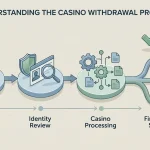
Identity checks can affect when funds are released. Identity should be verified before the first withdrawal; leaving this until a payout is requested can create avoidable delays while the operator completes its checks. The casino’s cashier and account terms should explain what information is required and how a withdrawal request is tracked. A quick payment estimate does not remove verification steps.
A practical comparison therefore separates the amount needed to deposit from the amount ultimately received and the time taken for it to arrive. The minimum deposit is not a measure of withdrawal speed, and a fast advertised method does not establish that it is fee-free. For online casino gambling with real money, the relevant terms are the selected payment method’s minimum, any stated withdrawal charge, the operator’s processing estimate, and whether a pending request can be reversed. Only sites authorised by the UK Gambling Commission may legally provide online gambling to players in Great Britain.
Online slot payout percentages: what they mean
How Online Slot Machines Are Tested and Reported
Online slot machines rely on a random number generator (RNG) to determine outcomes. For operators licensed by the UK Gambling Commission, the RNG must be certified and examined by an independent testing house approved for that work. This requirement provides an external check on the system that produces game results; it is not a promise that any individual spin, session or player will receive a particular return.
Testing and reporting answer different questions. An RNG examination concerns how outcomes are generated and whether the system has been assessed against relevant standards. Return to Player (RTP) describes a game’s theoretical return over extended play, rather than the result of a short session. A published RTP figure is therefore not a forecast of what a particular player will win, nor does it establish that the same amount will be returned during a particular period.
The distinction matters when considering online slot machines in Great Britain. A certification record may indicate that a testing process has taken place, but it does not, by itself, show how much a game returned to players in practice. Conversely, an operator’s report of actual returns is a record of results over a stated period; it does not replace independent examination of the RNG. Treating these as separate forms of evidence avoids reading a test certificate as a payout statement, or an actual-return figure as proof of how a game’s software was tested.
RNG Certification
An external check by an approved testing house ensuring the integrity of the random process.
Theoretical RTP
A long-run game property describing the expected return over extensive play.
Actual RTP
A record of outcomes observed over a defined period for specific games or categories.
Disclosure also varies. Some software developers publish RTP figures for their slot machines, while others do not. Where a figure is available, its value depends on what it describes: theoretical RTP is a long-run game property, whereas actual RTP records outcomes over a defined period. A report is more informative when it identifies the period and the games or categories included, rather than presenting a figure without a clear scope.
A specialist review describes RNG certificates as running for twelve months, with spot checks during the certificate period. That account should be treated as a description from that type of source, not as a universal schedule for every game or testing arrangement. The relevant point is that certification and later checks concern the integrity of the random process; the existence and scope of a certificate still need to be established for the specific game or system being considered.
Similarly, a specialist review reports that a growing minority of UK operators publish monthly actual RTP figures alongside theoretical returns, sometimes organised by game category. This is a reported practice, not a basis for assuming that every operator provides such data. When an operator does publish figures, the reporting period and category definitions affect what can be inferred. A category-wide result cannot necessarily be applied to an individual title, and an observed result over a limited period may differ from the game’s theoretical return.
3-Reel Slots in the UK: Rules, Odds and Play
Live casino games are a separate format from RNG-based slots: their outcomes are not generated by a slot machine’s RNG. Evidence about slot testing and slot RTP should therefore not be carried over to live casino play without information specific to that format. For online slot play, the clearest picture comes from keeping the evidence distinct: independent examination of the RNG, the game’s stated theoretical RTP, and any separately reported actual returns.
Responsible Gambling Measures on Casino Sites
Responsible gambling tools are account controls intended to limit or interrupt play. At UK Gambling Commission-licensed sites, deposit limits, time-outs and self-exclusion must be available. Their presence is useful, but the practical value of each depends on how it is set and whether it fits the player’s circumstances.
A deposit limit restricts the amount that can be added to an account over a selected period. Remote operators must prompt new customers to set a financial limit before their first deposit and make account-level limit controls accessible. Limits should be set before a gambling session begins, rather than after spending has already occurred. A limit is a boundary on deposits, not a measure of affordability or a guarantee that gambling will remain within a personal budget.
Other controls address different aspects of play. A loss limit can constrain losses, while a session reminder draws attention to time spent gambling. These tools do not replace deposit limits: each tracks or restricts a different aspect of activity. In particular, a reminder is not the same as a time-out, which allows play to be paused. The terms and operation of controls should be clear in the account interface, including what happens when a limit is reached or a break is activated.
Responsible Gambling
- Set a financial deposit limit before the session begins
- Identify the location of time-out and self-exclusion options
- Review how session reminders function in the interface
- Locate contact information for support organisations like GamCare
Self-exclusion is intended for a more sustained interruption. It differs from a time-out in purpose and should not be treated as a routine session setting. A player considering self-exclusion should be able to find the relevant account option and understand its effect before confirming it. Support organisations, including GamCare and Gamblers Anonymous, can also provide assistance beyond the controls available within a casino account.
The same safeguards matter when gambling takes place on a mobile site or app. A control that exists in an account menu is less useful if it is difficult to locate during ordinary use. Account pages should make limits, time-outs, self-exclusion and support information accessible, rather than placing them behind unclear labels. A review of casino services can describe which controls are available, but the existence of a feature alone does not establish how effectively it will reduce harm.
These measures are safeguards, not evidence that gambling is risk-free. Deposit limits can restrict the flow of funds into an account, but they do not make gambling losses recoverable. Time-outs and self-exclusion interrupt access, while support services address needs that account settings cannot. Taken together, the controls provide distinct ways to restrict activity; they are most meaningful when set before play and understood as limits on gambling, not as a means of managing its financial returns.
Comparing Slot Sites and Their Apps
Comparisons of slot sites and their apps are more useful when they examine the information each platform makes available, rather than treating a polished interface as evidence of better play. A mobile app and a mobile website may provide access to similar games, but the relevant question is whether key details are easy to find and presented consistently across both.
5-Reel Slots in the UK: Features and Play
A practical comparison can consider how clearly the catalogue is organised, whether game information can be reached from the game screen, and whether account and support information remains accessible on a smaller display. These are features to inspect, not guarantees of quality. An app’s presence in an app store, or a site’s compatibility with a phone, does not establish how a game performs or what its long-term return will be.
Return to Player (RTP) information needs particular care. The theoretical RTP describes a game’s expected return over extensive play, not the result a particular player should expect in a session. Some software developers publish RTP figures for their slots, while others do not. Where a site displays a figure, a comparison should note whether it identifies the game and the relevant version, and whether the value is clearly distinguished from results observed in actual play.
A specialist review has reported that a growing minority of UK operators publish monthly actual RTP figures alongside theoretical returns, separated by game category. That is a report about the market, not evidence that every platform provides such data or that the figures are directly comparable. Before drawing conclusions, the scope and method behind any published actuals matter: category-level totals cannot necessarily describe one game, and results from a period of play should not be mistaken for a prediction.
RTP Misunderstandings
A UK Gambling Commission study from 2014 found that specialist terminology, mathematical ideas, and the way explanations were formulated in English could lead some people to misunderstand how RTP worked.
App and site disclosures can also differ in visibility. A figure available in a help page may be less readily assessed than one shown alongside the game, while an app may organise the same material differently from its browser version. Comparisons should therefore record where the information appears and what it covers, rather than simply marking a platform as transparent or opaque.
The UK Gambling Commission permits gambling risks to be communicated through RTP or house-edge percentages; these are equivalent expressions of the same relationship. Yet terminology can still impede comparison. A Commission study found that some people unfamiliar with the industry did not understand RTP messages, with technical language, mathematical formulations and English wording contributing to difficulty. Clear presentation is therefore relevant alongside the presence of a figure.
For slot sites and apps, the strongest comparison is a descriptive one: what return information is published, whether actual results are distinguished from theoretical values, and how readily those details can be found. Such checks identify differences in disclosure without implying that an app or platform is superior on the basis of presentation alone.
Progressive Jackpots and the Cost of Chasing Them
A progressive jackpot grows as players contribute to a shared prize pool through their wagers. This changes how a slot’s theoretical return is divided: part is allocated to the base game, while another part funds the jackpot. The prize is therefore not an additional benefit with no cost attached to play. Each wager helps build the pool, whether or not that spin wins.
High-Volatility Slots in the UK: How Payouts Work
A specialist review has described contributions as typically ranging from 1% to 3% of each total wager. That figure should be treated as a reported estimate, not a fixed rule for every progressive slot. The contribution rate and the way a game accounts for it can vary, so the game’s own information is more relevant than a general figure when assessing a particular title.
The same review puts base-game Return to Player (RTP) for some progressive slots in the 88–92% range, with the portion not allocated to the base game going towards the jackpot. This is not an established rate for all games, and it should not be read as a guaranteed return for an individual player. RTP describes a theoretical return over extensive play; it does not predict the result of a session or establish the chance of winning the jackpot.
The distinction matters when comparing UK online gambling slots. A headline jackpot can make a game appear attractive, but its size alone says little about the base game’s return or the odds of a jackpot win. Where the contribution and base-game RTP are not clearly explained, the value of the trade-off is difficult to assess. A large pool does not remove the cost built into each wager, nor does it show how likely any particular spin is to trigger the prize.
For online slot gambling in Great Britain, the relevant comparison is therefore not simply between jackpot totals. It is between the game’s disclosed structure and the player’s reason for choosing it: whether the appeal lies in the ordinary play, the chance of a progressive prize, or both. Chasing the jackpot means accepting that some of each wager is directed away from the base game. That cost persists across losing spins as well as winning ones.
Progressive Jackpot Cost
Wager Contribution
A portion of each stake (typically 1% to 3%) is directed away from the base game to fund the jackpot pool.
Base Game Return
The remaining portion (often in the 88–92% range) determines the theoretical return of the ordinary play.
Prize Accumulation
The shared prize pool grows continuously regardless of whether an individual spin results in a win.
This is a feature of jackpot funding, not evidence that a particular casino has altered a game’s outcome. UK Gambling Commission licensed casinos operate within a regulated framework, but licensing does not make a jackpot more attainable or turn its displayed value into a measure of likely return. The pool’s growth and the base game’s return describe different parts of the same wager.
Free Slots, Free Spins and Their Limits
Free play can describe different arrangements. A demonstration slot uses no real-money stake and does not create a cash balance that can be withdrawn. Free spins, by contrast, are promotional plays on a slot: they may produce winnings, but those winnings can be subject to conditions. A no deposit bonus is another form of promotion, and its terms may restrict how much of a resulting balance can be withdrawn.
The distinction matters because the word “free” describes the entry cost, not necessarily the status of any winnings. A player comparing free online slot gambling in the UK should establish whether the offer is a demo, a set of spins, or a no deposit promotion. The terms should make clear which games qualify, how winnings are treated and whether a withdrawal cap applies. Without those details, the headline offer alone cannot establish the value of the promotion.
Bonus Buy Slots in the UK: How They Work
A specialist review reports that free-spin winnings may be capped, with figures in the range of £50 to £100 cited in that review. This is a report about the offers it examined, not a universal limit or a current market rule. Such a cap can prevent a larger win from being paid in full, so the stated maximum is material even where the spins themselves require no cash stake. The review also indicates that free-spin winnings may not be eligible for a jackpot payout.
For no deposit winnings, the same type of specialist review describes maximum withdrawal caps in the £50 to £100 range. That claim should likewise be treated as an observation from a particular review, not as evidence that all sites impose the same limit. The applicable terms for an individual offer determine whether a cap exists and how it operates. A maximum withdrawal is distinct from the amount displayed in an account: a balance shown after play does not, by itself, establish what can be paid out.
Free gambling slots can therefore be useful for observing a game without staking cash, while promotional spins and no deposit offers require closer reading of their conditions. Clear, accessible terms are relevant to safer online gambling because they allow the difference between play, winnings and withdrawable funds to be understood before an offer is accepted. Free play is not evidence that a promotion has no restrictions, and a cap stated in one review should not be assumed to apply elsewhere.
Attention The word "free" refers to the entry cost and does not mean winnings are unrestricted; caps may apply to withdrawals from free spins or no deposit bonuses.
Bonus Offers and the Turnover They Require
A bonus advertised as a match can look like extra balance, but the wagering requirement determines how much must be staked before the bonus-related funds can be withdrawn. The calculation is the qualifying bonus amount multiplied by the wagering multiple. Turnover means the total value of qualifying bets, not the amount of money that must be deposited.
For illustration, a specialist review describes a 100% match on a £50 deposit with wagering set at 35 times the bonus alone. The bonus is £50, so the required turnover is £1,750 before withdrawal. The deposit is not included in that calculation because the stated requirement applies only to the bonus. If terms instead calculate wagering on the deposit and bonus together, the qualifying balance is larger; the basis of the multiple therefore matters as much as the number itself.
A separate specialist review characterises requirements of 40 to 60 times as standard. On a £10 bonus, that would mean £400 to £600 in turnover before withdrawal. This is a description from that review, not a universal condition: offers vary, and the advertised headline does not establish which calculation applies. The precise terms attached to an offer are the relevant evidence.
Turnover requirements can delay access to funds because a player must complete the stated qualifying play before the offer’s withdrawal condition is met. It is important to distinguish the bonus amount from the required turnover: a modest bonus can entail substantially more betting than its face value suggests. Bets may also count differently across games, so the conditions should identify which play qualifies and whether any games contribute less or do not count.
Offers described as having no wagering requirement remove this particular turnover condition; the phrase alone does not establish that there are no other terms. A bonus may still have conditions governing eligibility, use or withdrawal. Likewise, a no-deposit offer should not be treated as cost-free without checking what must be done before any resulting funds can be withdrawn. These are separate issues from the limits that may apply to free-spin winnings.
Casino Games: Slots, Crash Games and More
A useful comparison records the bonus amount, the wagering basis, the multiple, eligible play and any withdrawal conditions. If the terms do not make the calculation clear, the headline offer is insufficient to establish the actual commitment required.
Assessing Newly Launched UK Casino Sites
A recent launch date is not evidence of either quality or poor practice. The more useful starting point is whether the operator holds a current UK Gambling Commission licence for the service it offers to players in Great Britain. Remote operators serving this market must be licensed, and a familiar game title does not replace that requirement: offering Book of Kings Slot to UK players, for instance, requires a UK Gambling Commission licence.
Testing evidence provides a separate check. UKGC-licensed operators must use a certified random number generator examined by an independent, approved testing house. For a newly launched casino, the relevant question is whether its information identifies the testing and certification behind the games, rather than merely using broad claims such as “fair” or “secure”. Where details are not available, the absence should be treated as an unresolved point, not as proof that testing has or has not occurred.
Classic Slots Online in the UK: How They Work
These checks establish limited conclusions. A licence indicates that the operator is authorised to provide gambling services in the market; testing evidence concerns the random number generation used by games. Neither establishes that a new platform will provide a better experience than an established one, nor does a launch announcement demonstrate sustained performance.
Comparisons should therefore distinguish verifiable regulatory and testing information from promotional language. If the licence status cannot be confirmed or testing claims cannot be traced to independent examination, there is insufficient evidence to treat the claim as established. New UK online casinos can be assessed on the same documented basis as older sites, while their short operating history remains a reason not to infer more than the available evidence supports.

Aviator Casino Game UK: Regulation and Evidence
The guide separates UKGC-authorised gambling in Great Britain from offshore access and reviews what can...

3-Reel Slots in the UK: Rules, Odds and Play
A guide to real-money stakes, free-play limits, slot features and the UK licensing context for...

5-Reel Slots in the UK: Features and Play
A clear guide to reel layout, game-specific rules, volatility, demo play and the limits of...

Bonus Buy Slots in the UK: How They Work
A bonus buy changes how a round begins; the game’s terms and bonus content still...

UK Online Casino Payouts: Keno Returns vs Speed
Keno return figures describe game outcomes over repeated play, while withdrawal processing is a separate...

UK Casino First Deposit Bonuses: How to Compare Terms
The advertised value alone is not enough: qualifying games and what happens when conditions are...

High-Volatility Slots in the UK: How Payouts Work
Volatility describes the balance between how often wins occur and their size, not when a...

Keno at UK Online Casinos: Terms and Game Play
Game rules, number picks, draw mechanics and house-edge estimates shape what can be concluded about...

Low-Volatility Slots in the UK: Returns and Risk
Low volatility describes how returns are distributed over play, not when a win will land...

Online slot payout percentages: what they mean
A payout percentage may describe a game, a group of games or broader results, so...

Progressive jackpot slots: how pools and wins work
A practical guide to pool funding, shared networks, eligibility, bonus limits and the trade-off between...

Best RTP Casino Slots in the UK: RTP Explained
RTP describes a slot’s theoretical long-run payout share, while volatility concerns the pattern of wins...

Video Slots in the UK: Returns, Rules and Play
Explore how slot rules, volatility and bonus features shape play, and why a short session...

Casino Dice Games in the UK: Formats and Sites
Dice-related labels can cover different game formats, while the titles available depend on each individual...

Chicken Road Casino Game in the UK: What Is Verified
The name and “slot” label alone do not confirm gameplay, availability, demo options or a...

Classic Slots Online in the UK: How They Work
A result depends on the symbols and positions that form a qualifying combination under the...

Crash Casino Games in the UK: Licensing and Offers
Understand how crash games fit into casino categories and what licensing, payment methods, demos and...

Fastest Payout Casinos in the UK: What It Means
Payout speed can describe different stages, from handling a withdrawal request to funds becoming available...

Fruit Machine Slots UK: How Online Games Work
See how digital fruit slots use RNGs, recreate familiar features and differ across real-money and...

Hi-Lo Casino UK: Rules, Live Play and Strategy
Hi-Lo outcomes depend on card rank, tie rules and whether a correct call builds a...

High-RTP Slots in the UK: What Can Be Verified
RTP, volatility, game features and UK rules each affect what slot comparisons can—and cannot—show. What...

JetX Casino Game in the UK: Format and Play
Explore how JetX is classified, what demo play can establish, and what to consider about...

Mines Casino Game in the UK: Rules and Licensing
Separate confirmed game information from claims about demos, bonuses and strategy, and understand the UK...

Online Bingo UK: Formats, Tickets and Slot Games
Ticket layouts, line prizes and full houses shape bingo play, while rooms, costs and slot...

Online Casino Games for Real Cash in the UK
A practical explanation of slot mechanics, casino checks, bonus conditions and how real-money payouts and...

Online casinos without ID in the UK: checks explained
A delayed document request is not the same as no verification: UK-licensed casinos must verify...

Penny Slot Machines UK: Stakes and Free Play
A practical guide to spin costs, free-play limits, bonus terms and checking published game details....

Plinko Casinos in the UK: Licensing and Play
A practical overview of UK casino regulation, Plinko categories, free-play evidence, randomness, bonuses and payment...

Progressive Slots Online in the UK: How Jackpots Work
See how connected wagers build jackpot pools and how progressive slots differ from games with...