International Casinos for UK Players: Licensing Explained
 Available in GB

An overseas licence alone does not establish permission to serve Great Britain; compare access, safeguards, bonus terms and withdrawals.
Table of Contents
- What “International Casino” Means in the UK Market
- How International Casino Sites Reach British Visitors
- Commercial Ties Behind Some International Casino Brands
- No-Deposit Bonuses and the Cost of Wagering Conditions
- British Access and Free-Spins Offers
- Crypto Withdrawals: Speed and Value Volatility
- Non-GamStop Casinos and the Limits of Their Safeguards
- Assessing International Roulette and Live-Casino Claims
- What UK Players Should Know About Foreign-Casino Legality
What “International Casino” Means in the UK Market
In the British gambling market, “international casino” is a descriptive label, not a separate category of licence. It generally refers to an online gambling operator based outside the UK or licensed by an overseas authority. For the purposes of the UK market, however, the decisive distinction is whether the operator holds a licence from the UK Gambling Commission (UKGC) while accepting British customers. A site may be international in its ownership, location or licensing arrangements; none of those features alone establishes that it is authorised to serve customers in Great Britain.
A foreign casino, in this context, is an online gambling operator that accepts British customers without a UKGC licence. The term therefore describes the relationship between an operator and the British regulatory system, rather than simply where the company is based. An operator located abroad could hold a UKGC licence, while an operator licensed overseas but without a UKGC licence remains outside the UKGC system. The location of the business and its permission to serve a particular market are separate questions.
For UK players considering international casinos in 2026, payout timing is one practical detail to check. The verdicts below stick to the information available for each operator.
1. x3bet
Payout speed: 1-3 business days x3bet lists a payout speed of 1–3 business days.
2. NightLuck
Payout speed: 1-3 business days NightLuck lists a payout speed of 1–3 business days.
3. BeOnBet
Payout speed: 1-3 business days BeOnBet lists a payout speed of 1–3 business days.
4. WinBeast
Payout speed: 1-3 business days WinBeast lists a payout speed of 1–3 business days.
5. Revery Play
Payout speed: 1-3 business days Revery Play lists a payout speed of 1–3 business days.
6. Amunbet
Payout speed: 1-3 business days Amunbet lists a payout speed of 1–3 business days.
7. Zombillion
Payout speed: 1-3 business days Zombillion lists a payout speed of 1–3 business days.
8. Jetsetspins
Payout speed: 1-3 business days Jetsetspins lists a payout speed of 1–3 business days.
9. Dieselwin
Payout speed: 1-3 business days Dieselwin lists a payout speed of 1–3 business days.
10. NightWin
Payout speed: 1-3 business days NightWin lists a payout speed of 1–3 business days.
This distinction matters because a licence issued by another jurisdiction does not substitute for a UKGC licence. An overseas regulator may supervise an operator under its own rules, but that authorisation does not make the operator licensed to provide gambling services in Great Britain. For online gambling offered to customers in England, Scotland and Wales, operators must hold the relevant Gambling Commission licence. In those parts of the UK, offering services without that licence is illegal for the operator.
The phrase “international online casino” can therefore be imprecise. It may refer to a company with operations in several countries, a casino licensed outside Britain, or a site that is simply described as international in its marketing. These descriptions do not answer the regulatory question. The relevant point is not whether a site has an overseas licence or an international customer base, but whether it holds the UK authorisation required to serve customers in Great Britain.
The same distinction applies when terms such as “online casino international” or “international casino online” are used. They can describe a broad category of websites, but they do not indicate a common legal status. A casino’s website, games or payment options cannot by themselves establish that the operator is authorised in Britain. Nor does the use of a familiar brand name resolve the question: authorisation attaches to the operator and the activity it is permitted to conduct, not merely to a name that appears on a site.
USA Casinos for UK Players: Licensing and Risks
“Offshore casino” is another common description for an operator outside the UKGC framework. In this usage, offshore does not necessarily mean that the business is unlawful everywhere or that it has no licence at all. It means that the operator is not regulated by the UK Gambling Commission. Such a casino may hold an overseas licence, but that licence does not confer permission to offer gambling services to customers in Great Britain. Conversely, the label “international” alone does not establish that a site is offshore or unlicensed; the operator’s actual authorisation is what matters.
The legal framework concerns operators and players differently. An online gambling site cannot lawfully offer its services in England, Scotland and Wales without the required Gambling Commission licence. That restriction does not create a criminal prohibition on an individual British player placing a bet with an overseas operator. There is no UK law that makes the act of betting with an overseas casino illegal for the player. This distinction should not be confused with approval of the operator: the absence of a criminal penalty for the individual does not make an unlicensed operator authorised to serve the market.
For that reason, “international casinos for UK players” is best understood as a description of sites that British visitors may encounter, not as a statement that every such site is approved for British customers. The label can encompass operators with different locations and overseas licensing arrangements, while the UKGC question remains separate. Where an operator lacks a UKGC licence, it is outside the UKGC’s regulatory system and does not provide UKGC-mandated affordability checks. An overseas licence does not change either point.
An overseas licence does not substitute for a UKGC licence and does not authorise an operator to provide gambling services in Great Britain.
The most precise terminology keeps these issues distinct: international describes a business’s cross-border character; overseas or offshore describes its position outside the UK; and UKGC-licensed identifies an operator authorised under the British regulatory framework. Those terms are not interchangeable. In particular, the presence of an overseas licence should not be read as evidence of UK authorisation. The defining question for an international casino in the UK market is whether the operator holds a UKGC licence to provide gambling services to customers in Great Britain.
How International Casino Sites Reach British Visitors
A website’s availability from a British internet connection does not establish that its operator is authorised to serve customers in Great Britain. Some casinos licensed outside the UK are expected to prevent access from British visitors. However, a report by gambling.com says that some sites do not consistently apply those restrictions and that a basic VPN can be used to get around an access block. This is a reported account, not a guarantee that any particular international casino site is accessible, or that access will remain possible.
The distinction matters because a visible website and a permitted service are not the same thing. An offshore operator may have a licence issued in another jurisdiction, yet that licence does not authorise it to provide gambling facilities in Great Britain. Remote operators serving the British market need the relevant UK Gambling Commission licence. Offshore casinos are outside the Commission’s regulatory system and are not regulated by the UKGC.
Non-UK-Registered Casinos: How Regulation Works
Why access can differ from authorisation
Access controls are practical barriers, not proof of regulatory status. A site may be available to view while still being unauthorised to accept British customers. Conversely, a site may restrict access from Britain even if its pages can be found online. The relevant question is not simply whether a page loads, but whether the operator is entitled to serve customers in the market.
Location restrictions may also be applied inconsistently. The gambling.com report describes non-UK-licensed casinos that are supposed to block British visitors but do not enforce that restriction in every case. It also notes that users can bypass a block with a basic VPN. This should be understood as a description of reported access conditions, rather than a stable feature of international online casino sites. Operators can change their controls, and the ability to reach a site at one point does not establish that an account can be opened or used later.
A VPN can make a connection appear to come from another location, but it does not change the operator’s licence or bring the casino under UKGC oversight. Nor does it provide the protections associated with a UK-licensed service. Treating circumvention as a way to establish legitimate access would therefore confuse a technical route to a website with permission to operate in Britain.
What can happen after access
The practical risk is not limited to whether a site accepts a visitor. If a dispute arises, a British customer at an offshore casino does not have the UKGC regulatory framework behind the service. The operator is not regulated by the Commission, and UKGC-mandated affordability checks do not apply to it. These differences are relevant even where the site appears professionally presented or allows account activity without an obvious access barrier.
Financial Risk
British customers at offshore casinos lack UKGC regulatory protections, which can leave them without legal recourse if an unlicensed site refuses to pay winnings.
A report by gambling.com also describes cases in which unlicensed sites refused to pay customers’ winnings, leaving those customers without legal recourse. That is a reported risk, not evidence that every offshore operator withholds payments. It does, however, illustrate the difficulty of relying on a site’s apparent accessibility as an indication of what will happen if a disagreement occurs. A payment dispute with an operator outside the UKGC system is not equivalent to a dispute involving a British-licensed casino.
The same caution applies to claims made on a site’s own pages. A foreign licence may be relevant to the operator’s status in the issuing jurisdiction, but it does not amount to UKGC regulation. A site’s willingness to accept a British visitor, or the absence of a visible block, cannot substitute for authorisation to serve the British market.
A practical distinction
For British visitors, three separate matters are often blurred: whether a site can be reached, whether its operator accepts customers from Britain, and whether the operator holds the licence required to serve the market. A positive answer to the first does not establish the other two. A VPN may alter the apparent connection location, but it does not resolve the licensing question or restore UK regulatory protections.
Accordingly, the phrase “international casinos for UK players” can describe sites that are reachable from Britain, but it should not be read as confirmation that those sites are authorised for British customers. Access conditions can vary and may change; regulatory status is a separate matter. The risks described in reports about blocked access and unpaid winnings are reasons to distinguish technical availability from a regulated service, rather than to treat an accessible site as a dependable one.
Commercial Ties Behind Some International Casino Brands
A relationship between a casino operator and another business can matter as much as the name displayed on a gambling site. The commercial terms behind a brand may create incentives that are not apparent from its public-facing presentation. A documented arrangement involving Santeda and SIS illustrates why the source of a company’s revenue can be relevant when assessing international casino brands.
Gibraltar Casino Licences in the UK: What They Mean
Under their contract, SIS received a percentage of revenues generated by losing bets placed through Santeda’s brands. This links SIS’s income to gambling losses rather than simply to the number of customers or the volume of bets. The arrangement is therefore relevant to questions about commercial alignment: the parties’ financial interests were connected to losses made by players using those brands.
That description should be kept precise. It establishes a revenue-sharing connection tied to losing bets; it does not, by itself, establish how either party acted towards customers or whether the arrangement affected particular products, promotions or decisions. A financial incentive is a reason to examine a relationship, not proof of misconduct. The distinction matters because the existence of a contract can be documented without supporting broader conclusions about its practical consequences.
The relationship also shows why a casino brand should not automatically be treated as an independent business. A brand may be the public identity through which bets are placed, while contractual arrangements link its revenues to another organisation. In Santeda’s case, the relevant connection is not merely that SIS had a commercial relationship with the company. The stated basis of payment tied SIS’s share to revenues from losing bets across Santeda’s brands. That is a more specific claim than a general description of a business partnership.
For someone comparing international casinos, this kind of detail belongs in an assessment of ownership and commercial relationships, not in a simple comparison of welcome offers or game catalogues. The label on a site may identify the brand but say little about which companies have a financial interest in activity under that label. Where revenue-sharing is involved, the terms can also help distinguish ordinary service provision from arrangements in which income is connected to customer losses.
Santeda’s licensing position is also relevant to the boundaries of the case. Its Curaçao licence does not permit it to operate in the UK or the United States. A licence issued in one jurisdiction should not be read as permission to serve customers in another. Santeda’s brands are not regulated by the UK Gambling Commission, and the contract with SIS does not change that position. The commercial relationship and the regulatory question are separate matters: one concerns how revenue was shared, while the other concerns where the operator was authorised to provide gambling services.
Malta MGA-Licensed Online Casinos in the UK
This distinction prevents two common analytical errors. First, a commercial tie should not be treated as evidence that every brand or company connected to an operator has the same role. The stated agreement identifies SIS as receiving a share of relevant revenues; it does not, on its own, describe SIS as the operator of Santeda’s brands. Second, licensing information does not explain the financial terms of a contract. A jurisdictional licence and a revenue-sharing agreement answer different questions and should not be substituted for one another.
The documented arrangement is therefore significant in a limited but clear way: it connects SIS’s remuneration to revenues from losing bets placed through Santeda’s brands. That connection warrants attention when considering the incentives embedded in a commercial relationship, while leaving separate questions about conduct, customer treatment and the agreement’s effects to evidence that addresses those matters directly. For international casino comparisons, identifying who benefits financially from player losses can add context that brand names and promotional descriptions alone do not provide.
No-Deposit Bonuses and the Cost of Wagering Conditions
A no-deposit bonus is promotional credit offered without requiring an initial deposit. The label can make an offer sound immediately usable, but it does not establish that the credit can be withdrawn as cash. The terms attached to it determine what must happen before any winnings become eligible for withdrawal.
Specialist reviews describe deposit matches, free-spins packages, no-deposit bonuses and cashback as common promotional formats at foreign casinos serving British players. A specialist review also reports that offshore welcome packages can be larger because operators outside the UK Gambling Commission’s system are not bound by its restrictions on bonus terms, wagering requirements and promotional language. That is a reported comparison, not a guarantee that every international casino has a larger offer or that a larger headline value is more advantageous.
The central condition to examine is the wagering requirement. It sets the amount of qualifying bets that must be placed before bonus funds, or winnings linked to them, can become withdrawable. The multiple may apply to the bonus alone or to the combined value of a deposit and bonus; the offer’s wording matters. A headline sum therefore cannot be assessed in isolation from the calculation base and the games that count towards it.
Bonus Calculation
Step 1: Identify the bonus and requirement
A £100 deposit match bonus with a 35x wagering requirement.
Step 2: Calculate total qualifying bets
£100 (bonus) × 35 (requirement) = £3,500.
Step 3: Determine the outcome
£3,500 in qualifying bets must be placed before the bonus funds convert to withdrawable cash.
A specialist review’s worked illustration shows the scale of the commitment: a £100 bonus matching a deposit in full, with a 35x wagering requirement, calls for £3,500 in qualifying bets before the bonus funds convert to withdrawable cash. This is an illustration of how the calculation works, not a standard term for international casino bonuses. A no-deposit offer may have a different basis or other conditions, so the same calculation should not be assumed to apply across offers.
The distinction between bonus credit and cash is particularly important with no-deposit promotions. A balance displayed in an account may remain promotional until the wagering condition is completed. The terms may also specify which games qualify, whether different games contribute differently, and whether a cap applies to winnings. Those details affect the practical value of an offer; the advertised amount alone does not show how readily it can be converted into a withdrawal.
Before comparing an international casino welcome bonus with a no-deposit offer, the relevant terms include the wagering multiple and its calculation base, the qualifying games, any maximum withdrawal from bonus play, and any stated time limit. Where these details are unclear, the value of the promotion cannot be reliably assessed. A large headline figure is not equivalent to cash available on demand.
There is also a regulatory distinction. Offshore casinos are not regulated by the UK Gambling Commission, and they do not provide UKGC-mandated affordability checks. A promotion at a casino not on GamStop is not made safer or more favourable simply by being accessible to British customers. The bonus rules are set by the operator, and the protections and oversight applying to UKGC-licensed operators do not automatically extend to an offshore offer.
Wagering conditions turn a promotional balance into a conditional one. Comparing the calculation and restrictions, rather than the headline amount, gives a more accurate account of what a no-deposit bonus or welcome package may be worth.
British Access and Free-Spins Offers
Access from Britain does not necessarily reflect an operator’s stated policy. Some casinos licensed outside the UK are expected to restrict British visitors, yet a report by gambling.com says that some do not enforce those blocks; it also notes that users can get around them with a basic VPN. This is a report about observed access, not evidence that a particular site is authorised to serve the British market or that access will remain available.
Online casinos with no sister sites in the UK
For an international casino site that accepts visitors from the UK, the distinction between being reachable and being permitted to provide gambling facilities matters. Remote operators serving customers in Great Britain must hold a UK Gambling Commission licence. Offshore casinos are outside that regulator’s system, and they do not offer UKGC-mandated affordability checks. A site loading in a browser, or appearing in an app, does not establish that it has the required licence.
Promotional formats are another part of the picture. A specialist review of foreign casinos serving British players identifies deposit matches, free-spins packages, no-deposit bonuses and cashback offers among the recurring types. That account describes a range of promotions, not a uniform package available at every operator. The label “free spins” alone also says little about eligibility: an offer may be presented separately or as part of a broader promotion, and its terms determine what the spins can be used for and whether any resulting balance can be withdrawn.
The phrase “free spins without deposit” therefore needs careful reading. It describes a promotion that purports not to require a deposit to access the spins; it does not, by itself, establish the conditions attached to winnings or the availability of the offer to British customers. Those details need to be assessed from the specific terms, rather than inferred from the headline.
Mobile access should be considered separately from the offer itself. A casino app or mobile site may provide a route to the operator, but neither the format nor the presence of promotional banners changes the operator’s licensing position. Availability can also be affected by the access restrictions described above. Consequently, British accessibility and free-spins advertising are evidence of what a visitor may encounter, not proof of UK authorisation or equivalent regulatory protection.
Crypto Withdrawals: Speed and Value Volatility
Crypto can make an international casino withdrawal appear faster than a conventional payment, but speed is only one part of the outcome. A specialist review reports that withdrawals from foreign casinos often clear in under an hour, describing them as faster than fiat methods. That is a reported comparison, not a guarantee for every operator or transaction. The time taken may depend on the casino’s own processing as well as the payment route.
The more distinctive trade-off is volatility. A cryptocurrency’s value can change while a withdrawal is being processed or before it is converted into pounds. The amount credited in crypto and the amount ultimately realised in sterling may therefore differ. A fast transfer does not remove that uncertainty: speed describes how quickly the transaction clears, not the value retained when the funds are exchanged.
This matters when comparing a crypto balance with a fixed sterling amount. The exchange value may move in either direction, so the sterling outcome is not necessarily predictable from the balance shown at the point of withdrawal. Any assessment of a crypto casino should distinguish the stated crypto amount from its changing value in pounds, rather than treating them as equivalent.
Crypto payment availability also does not establish that a casino is authorised to serve customers in Great Britain. Offshore casinos are not regulated by the UK Gambling Commission, and they are not subject to UKGC-mandated affordability checks. A payment method cannot replace those protections or provide equivalent UK regulatory oversight. The legal and consumer-protection position of the operator remains separate from the speed of its payment processing.
Accordingly, the reported speed advantage should be read narrowly. It concerns the clearing time described in specialist coverage; it does not establish that every withdrawal will be completed within the same period, nor that the value received will remain stable. For a British customer, the relevant comparison is therefore not simply crypto versus fiat on speed. It also includes the possibility of a changing sterling value and the absence of UKGC regulation and affordability requirements at an offshore site.
Non-GamStop Casinos and the Limits of Their Safeguards
GamStop is connected to the UK Gambling Commission’s licensing system: every UKGC-licensed operator is covered by the scheme. Registering a self-exclusion therefore blocks access to all UK-licensed gambling sites. Casinos operating outside the Commission’s remit are not required to participate, so a GamStop exclusion does not extend to them.
Because casinos operating outside the UK Gambling Commission’s remit are not required to participate in GamStop, a self-exclusion through that scheme does not extend to offshore operators.
That distinction has practical consequences. A specialist review reports that a person who has self-excluded may be able to register with a foreign casino and deposit without the protections associated with UK-licensed sites. The report describes a potential route around a deliberate barrier, not evidence that such access is safe or appropriate. In particular, offshore operators do not provide UKGC-mandated affordability checks, and they are not regulated by the UKGC.
Security claims should be considered separately from those limits. Some accounts of non-GamStop casinos describe encryption intended to protect personal and financial information. Encryption can help secure data in transit or storage, but a claim about that technology does not establish the quality of a site’s wider controls, its response to a dispute, or the availability of effective player protection. Nor does technical security make an operator part of GamStop.
Licensing is another separate question. A specialist review may describe a platform as licensed by an overseas authority, but that does not mean it holds a UKGC licence or is subject to UKGC oversight. The existence of a licence claim should not be treated as evidence that safeguards match those required of operators serving the British market.
For anyone who has self-excluded, the central issue is therefore not whether a foreign site accepts registration, but that its systems may not honour the exclusion or provide the same intervention mechanisms. The gap between data security, an overseas licence and responsible-gambling protection matters: these are different protections, and one does not demonstrate the presence of the others.
Assessing International Roulette and Live-Casino Claims
Roulette and live-dealer descriptions can sound specific while leaving important details unclear. A review of an international casino should distinguish what the operator explicitly states from what can be independently confirmed. The word “live”, for instance, is not by itself evidence of how a table is run, which rules apply or whether the same offering is available to British visitors.
Useful points to examine include the roulette format, the stated rules, the table’s betting limits and whether the casino identifies the game provider. These details should be visible in the game information or terms rather than inferred from promotional wording. If the description does not explain a material feature, a review should identify that gap instead of treating an assumption as a fact.
Live-casino claims also warrant careful reading. A presentation featuring a dealer or streamed table does not, on its own, establish the rules, operating arrangements or reliability of the service. Reviews are more informative when they separate observable details from claims that cannot be substantiated. They should not imply that a named provider or particular roulette title is available unless that has been checked for the relevant site and market.
The distinction between an attractive game description and a dependable service matters because international casinos operating outside the UK system are not regulated by the UK Gambling Commission. They do not provide the protections associated with UKGC oversight, including UKGC-mandated affordability checks. A polished live table or detailed roulette lobby does not alter that regulatory position.
Review quality depends partly on whether it describes the limits of its own assessment. A general statement that a casino offers live roulette is less useful than an account of what was verified, where the information appeared and what remains uncertain. Comparisons should apply the same standards across sites and avoid presenting promotional claims as independent findings.
For British visitors, the most cautious reading treats game descriptions as claims to assess, not proof of quality or suitability. Roulette rules and table details can be compared where they are disclosed; broader assurances about fairness or service require evidence beyond appealing presentation. An international casino review that makes those distinctions provides a clearer basis for understanding what is being offered without turning a game-category description into an endorsement.
What UK Players Should Know About Foreign-Casino Legality
The legal position of a British player and that of an offshore operator are distinct. A UK resident does not commit a crime merely by placing a bet with a casino licensed outside the UK. The Gambling Act does not impose a criminal penalty on the individual for doing so.
That does not make the operator’s activity lawful in Britain. An operator without a UK Gambling Commission (UKGC) licence must not advertise gambling services in the UK or provide gambling facilities to customers here. The restriction applies to the business serving the market, rather than making the player’s participation a criminal offence.
This distinction is important when interpreting claims that a casino is “legal” or “licensed”. An offshore licence may relate to the operator’s status in another jurisdiction, but it is not a UKGC licence and does not authorise the operator to serve British customers. Offshore casinos are not regulated by the UKGC, and they are not subject to its enforcement or consumer-protection requirements. In particular, they do not provide the UKGC-mandated affordability checks that apply within the British regulatory system.
Consequently, the absence of criminal liability for a player should not be read as evidence that an offshore casino has approval to operate in the UK, or that a player receives the same protections as at a UKGC-licensed site. The legal responsibility described here falls on the operator when it offers gambling facilities to UK customers or advertises those services in the country.
For anyone assessing international casinos for UK players, the central distinction is therefore not simply where a company is based or which foreign regulator has licensed it. The relevant UK question is whether it holds the authorisation required to serve the British market. A player’s lack of criminal liability does not change that requirement or confer UK regulatory status on an offshore site.
Real-Money Play, Withdrawals and Tax in the UK
For British residents, gambling winnings are not subject to income tax. That treatment does not depend on whether the casino is licensed by the UK Gambling Commission or operates under an overseas licence. Tax status and regulatory status are separate matters: winnings may be tax-free while the operator remains outside the UK regulatory system.
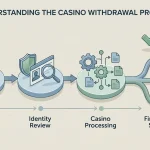
Cash-out arrangements require separate scrutiny. A specialist review of international casinos reports that withdrawal limits, pending periods and verification procedures differ considerably between operators. These terms can affect when funds become available and what information must be supplied before a payment is processed. The casino’s published withdrawal conditions therefore matter more than a general claim that real-money payments are quick.
Identity checks also vary in how they are handled. UKGC-licensed operators must verify a customer’s identity before processing a withdrawal; that requirement should not be assumed to describe the procedure at an offshore casino. Any request for documents, the stage at which checks occur and the effect of a pending period should be assessed against the individual operator’s terms.
International casinos that operate offshore are not regulated by the UK Gambling Commission. They are also not subject to UKGC-mandated affordability checks, so the protections attached to a British licence should not be presumed to apply. A casino’s own stated payment rules do not make it equivalent to a UK-licensed operator.
Non-UKGC-Licensed Casinos: Rules and Risks
The distinction is consequential for real-money play: tax treatment alone says nothing about the reliability or oversight of a withdrawal process. Conditions set by an international casino can differ from those familiar from the UK market, and they may determine whether a requested payment is delayed or capped. The relevant terms should be read as operator-specific rather than treated as a standard feature of all international casinos.
Are foreign casinos safe for UK players to use?
Not necessarily. An overseas licence does not provide UKGC protection, and unlicensed sites have sometimes refused to pay winnings, leaving players with no legal recourse.
Are bonuses at foreign casinos actually better than at UKGC-licensed sites?
They often offer larger welcome packages because they are not bound by UKGC restrictions on bonus terms and promotions. Check the wagering requirement: a 100% match bonus of £100 with a 35x requirement means £3,500 in bets before the bonus becomes withdrawable.
How do I know if an online casino is safe?
Check whether the operator holds a UKGC licence to serve customers in Great Britain. An overseas licence alone does not authorise a casino to serve the British market or give you UKGC protection.
What happens if I have a dispute with a foreign casino?
If the casino is outside the UKGC system, you do not have UKGC oversight to rely on. Some unlicensed sites have refused to pay winnings, leaving customers with no legal recourse.
What does wagering requirement actually mean in practice?
It is the amount you must wager before bonus funds can be withdrawn. For example, a 35x requirement on a £20 bonus means placing £700 in qualifying bets.
What is the fastest way to withdraw from an online casino in the UK?
E-wallets are generally the fastest option, with most operators processing withdrawals within 24 hours. At foreign casinos, crypto withdrawals can often clear in under an hour, but their value can fluctuate.
What should I do if a casino refuses to pay my winnings?
If it is an unlicensed foreign casino, you may have no legal recourse; such refusals have occurred at unlicensed sites. Check the operator’s UKGC status before depositing, as an overseas licence does not replace UK authorisation.

Anjouan Casino Licence in the UK: What It Means
An Anjouan licence is issued outside the UK and does not itself show that a...

Foreign Casinos for UK Players: Licensing and Risks
The guide explains what foreign status means in Britain and how licensing, safeguards, payments and...

Offshore Casino Sites in the UK: Licensing Explained
The operator’s location is not enough to establish whether its service for British customers is...

Offshore Casinos for UK Players: Licensing and Risks
An offshore operator is defined by accepting British customers without the relevant UKGC licence, not...

British Casinos Not on GamStop: Rules and Risks
GamStop participation follows UKGC licensing, while access, bonus conditions and player safeguards can differ at...

Casino no ID verification in the UK: what it means
An account opened without an immediate document request does not show that age and identity...

Casino Sites Not Registered with GamStop in the UK
GamStop covers UKGC-licensed operators, while sites outside that framework may not be connected to the...

No-ID-Verification Casino Withdrawals in the UK
Learn why “no verification” usually concerns when checks happen, and how licensing, payment methods and...

Non-UK Licence Casinos: How Regulation Works
A licence identifies the jurisdiction associated with an operator, but it does not make the...

UK Casinos Without a UKGC Licence: Rules and Risks
See how UKGC oversight differs from offshore licensing, and what that can mean for legal...

Casinos That Bypass GamStop: Rules and Risks
GamStop applies to participating UKGC-licensed operators, while offshore casinos may sit outside that framework and...

Curacao Casino Licence in the UK: Rules and Limits
A Curaçao licence signals a jurisdictional connection, not UK Gambling Commission supervision or proof of...

Gibraltar Casino Licences in the UK: What They Mean
A Gibraltar connection alone does not establish UK authorisation, customer recourse, responsible-gambling safeguards or data...

Merkur Casino Online UK: Games, Access and Licensing
A brand name alone cannot verify a casino operator, available games or access conditions; those...

How to Assess the Most Trustworthy Online Casinos in the UK
A practical framework for weighing licensing, public evidence, identity checks and gambling controls without treating...

No Account Casino UK: How Access Really Works
The label can describe a shorter entry process, but it does not establish what information,...

Non-Gamban Casinos UK: How Coverage and Exclusion Differ
Gamban coverage and GAMSTOP participation are different questions, and neither can be established by the...

Non-GamStop Curaçao casino sites: UK licensing explained
A Curaçao connection does not establish UK authorisation, an operator’s licence status or whether a...

Non-GamStop European Casinos: UK Access Explained
GAMSTOP participation, UK licensing and account exclusions are separate issues, so a European address alone...

Non-UK-Registered Casinos: How Regulation Works
A guide to UKGC oversight, offshore licensing, GamStop access, payments and protections that may not...

Non-UK Regulated Casinos: UK Rules and Licences
The operator’s licence determines whether a casino is regulated by the UKGC, even when the...

Non-UKGC-Licensed Casinos: Rules and Risks
The guide distinguishes UKGC authorisation from offshore licences and outlines differences in player protection, terms,...

Malta MGA-Licensed Online Casinos in the UK
MGA licensing sets requirements such as segregated player funds, while remote gambling in Great Britain...

Online casinos with no sister sites in the UK
A sister-site label may reflect common ownership or shared technology, and those connections do not...

Online Slots Not on GamStop: What the Term Means
GamStop participation concerns the casino offering a game, not the slot’s title, features or developer....

Safe Online Casinos in the UK: Licence and Safety Checks
An overview of licensing, player protections, account checks and payment terms that shape safety in...

Trusted Casinos Not on GamStop UK: What Trust Means
A clear distinction between reputation, overseas licensing claims and the protections attached to UKGC regulation....

Trusted UK Casinos: Licensing and Safety Checks
UK licensing provides a legal threshold, while verification, payment terms, enforcement and crypto claims need...

USA Casinos for UK Players: Licensing and Risks
The guide separates branding from licensing and examines payment, payout and player-protection claims for overseas...

VPN-Friendly Casinos UK: Access and Risks
VPN access may affect location checks and withdrawals, but it does not change a casino’s...