How to Assess the Most Trustworthy Online Casinos in the UK
 Available in GB

A practical framework for weighing licensing, public evidence, identity checks and gambling controls without treating comparisons or reviews as endorsements.
Table of Contents
- What a UK Casino Licence Establishes—and What It Does Not
- How Trustworthiness Can Be Assessed from Public Evidence
- GAMSTOP Status and the Limits of Non-GAMSTOP Claims
- Real-Money Play: Verification, Limits and Control
- Online Slots: Playing Conditions and Spending Rules
- Bitcoin Casino Claims and the Evidence Available
- Using the Separate Operator Comparison Without Treating It as an Endorsement
- What Casino Reviews Can—and Cannot—Show
- When a Casino’s Trustworthiness Cannot Be Verified
What a UK Casino Licence Establishes—and What It Does Not
A UKGC Licence is a necessary regulatory condition for a remote gambling business that offers facilities to consumers in Great Britain. The requirement applies whether the business is based in Great Britain or operates from elsewhere. For real-money gambling offered to customers in England, Scotland and Wales, the operator must hold a licence from the UK Gambling Commission (UKGC). The operator’s location does not remove that obligation.
This requirement sets a legal baseline, rather than identifying which casino is most trustworthy. A licence establishes that an operator is authorised to provide the relevant gambling facilities within the Commission’s regulatory framework. It also places that activity within the Commission’s remit for remote gambling offered to consumers in Great Britain. In that sense, licensing distinguishes regulated provision from an operator that lacks the required authorisation.
The geographic scope matters. Great Britain comprises England, Scotland and Wales; Northern Ireland is not covered by the Gambling Commission’s remit for remote-gambling provision in the same way. Accordingly, a statement about a UKGC Licence should not be treated as a complete description of gambling regulation in every part of the United Kingdom. The point relevant to a Great Britain-facing online casino is that the Commission regulates remote gambling offered to consumers there, and the operator must hold the relevant licence.
When choosing an online casino in the UK, it is worth checking the specific details available about each option rather than relying on a label alone. This list records the payout-speed information provided for each operator.
1. x3bet
Payout speed: 1-3 business days x3bet lists a payout speed of 1–3 business days.
2. NightLuck
Payout speed: 1-3 business days NightLuck lists a payout speed of 1–3 business days.
3. BeOnBet
Payout speed: 1-3 business days BeOnBet lists a payout speed of 1–3 business days.
4. WinBeast
Payout speed: 1-3 business days WinBeast lists a payout speed of 1–3 business days.
5. Revery Play
Payout speed: 1-3 business days Revery Play lists a payout speed of 1–3 business days.
6. Amunbet
Payout speed: 1-3 business days Amunbet lists a payout speed of 1–3 business days.
7. Zombillion
Payout speed: 1-3 business days Zombillion lists a payout speed of 1–3 business days.
8. Jetsetspins
Payout speed: 1-3 business days Jetsetspins lists a payout speed of 1–3 business days.
9. Dieselwin
Payout speed: 1-3 business days Dieselwin lists a payout speed of 1–3 business days.
10. NightWin
Payout speed: 1-3 business days NightWin lists a payout speed of 1–3 business days.
That status is meaningful, but limited. A licence is not a certificate that every aspect of a casino’s conduct is beyond criticism, nor does it establish that every customer will have a satisfactory experience. It cannot, by itself, demonstrate that an operator has never breached a requirement, that its customer service is effective, or that its terms will suit every player. Nor does the mere presence of a licence prove that a particular promotion, payment arrangement or account decision is fair. Those are separate questions requiring evidence about the operator’s conduct and practices.
The distinction is important because “trustworthy” is broader than “licensed”. Licensing answers a defined regulatory question: whether the business holds the authorisation required to offer remote gambling to consumers in Great Britain. Trustworthiness is an overall assessment that may involve how an operator behaves over time, how clearly it communicates, and how it responds when problems arise. A licence provides the starting point for that assessment, not its final verdict.
The same limit applies to comparisons between casinos. Two operators may both hold the necessary licence, yet the licence alone does not establish that they offer equivalent service or that one is more reliable than the other. Conversely, claims of polished presentation or a familiar brand do not substitute for the required authorisation. Regulatory status and broader judgements about reliability are related, but they are not interchangeable.
No Account Casino UK: How Access Really Works · Anjouan Casino Licence in the UK: What It Means
A responsible description should therefore avoid treating a UKGC Licence as a blanket guarantee. It is evidence of authorisation within a particular legal regime and geographic scope. It does not remove the need to assess other relevant evidence before reaching a wider conclusion about a trustworthy online casino. Equally, it would be inaccurate to dismiss the licence as merely symbolic: the requirement defines which remote gambling businesses may lawfully serve consumers in Great Britain under the Commission’s regime.
This baseline also prevents a common ambiguity in the word “UK”. A business may be incorporated or based outside the country while still offering gambling to people in Great Britain. Its overseas location does not, on its own, exempt it from the licensing requirement. The relevant issue is whether it offers remote gambling facilities to consumers in Great Britain, not simply where its offices or corporate registration are located.
For a casino described as trustworthy, then, a UKGC Licence establishes an essential regulatory threshold. It does not settle every question that the description implies. The clearest assessment keeps those propositions separate: authorisation is a necessary condition for serving the British market legally, while trustworthiness is a broader conclusion that must rest on further evidence.
How Trustworthiness Can Be Assessed from Public Evidence
A public record can provide evidence about an operator’s identity, regulatory position and past conduct. It cannot, by itself, establish that an operator is trustworthy in every respect. The most useful assessment therefore distinguishes what a record confirms from what remains uncertain, and avoids treating a single entry or enforcement action as a complete account of a business.
A register entry can connect a consumer-facing brand or domain with the legal business responsible for operating it, as brand names often differ from the legal names recorded by the regulator.
A register entry can help connect a consumer-facing casino brand or domain with the business responsible for operating it. That connection matters because a brand name may differ from the legal name recorded by the regulator. An affiliate review citing the Gambling Commission’s register identifies 333casino.com as a White Label domain associated with Grace Media (Gibraltar) Limited, under account 57869. This is a specific recorded relationship, not evidence that every casino using a white-label arrangement has the same operator or regulatory history. The entry should be read as information about the named domain and account, rather than as a general endorsement of the brand.
The practical value of a register check lies in matching identities carefully. A brand, a website address and a licensed business may be described differently, so a name that appears unfamiliar is not necessarily proof of a mismatch. Conversely, a similar name alone does not establish that a domain belongs to the business shown in a record. The relevant question is whether the public information connects the particular site being assessed to the named operator. Where that connection is unclear, the uncertainty should remain explicit rather than being resolved by assumption.
Register information and enforcement information answer different questions. An entry can indicate a recorded relationship between a domain and an operator; an enforcement record can show that the regulator took action over specified conduct. Neither type of information should be stretched beyond its scope. A record concerning one operator does not establish the conduct of every brand associated with it, and a past regulatory action does not, without further evidence, describe the present condition of every account or service.
Merkur Casino Online UK: Games, Access and Licensing · Curacao Casino Licence in the UK: Rules and Limits
Grace Media provides a concrete example of why conduct records add a separate dimension to an assessment. On 26 June 2025, the Gambling Commission imposed a financial penalty of £60,000 on the company. The stated breaches involved self-exclusion and consent for direct electronic marketing. This is material evidence about regulatory concerns identified in that case. It does not establish that every customer experienced the same issue, nor does the penalty alone show how the company’s practices may have changed since the relevant conduct.
The nature of the breach matters as much as the existence of a penalty. Findings involving self-exclusion concern whether a customer’s decision to stop gambling was respected; findings involving marketing consent concern whether electronic promotional contact was appropriately authorised. Those are distinct forms of conduct, and a careful account preserves that distinction instead of reducing the record to a broad label such as “safe” or “unsafe”. The penalty gives the assessment a documented basis, while the specified subject matter helps explain why the record is relevant.
For people considering which online casinos are trustworthy, public evidence is best treated as a way to test claims, not to produce an automatic verdict. A claim about corporate identity can be checked against a register relationship; a claim about regulatory conduct can be considered alongside enforcement records. The result may support a more informed assessment, but it cannot establish every aspect of service quality, future conduct or an individual customer’s experience. “Most trustworthy” is therefore not a conclusion that a single public record can settle.
Attention: A past regulatory action or penalty does not, without further evidence, describe the present condition of every account or service provided by an operator.
The date and scope of a record also matter. Regulatory information describes the position recorded at the time it was published or checked; it should not be assumed to remain unchanged indefinitely. Enforcement information relates to the conduct and findings specified in the relevant action. An assessment that omits those boundaries risks turning a dated, particular piece of evidence into a sweeping claim about an operator’s current performance.
A disciplined reading keeps three points separate: which business is connected to a domain, what the regulator has recorded about that relationship, and what enforcement history says about conduct. Where the evidence supports a conclusion, it can be stated narrowly. Where it does not resolve a question, that gap should not be filled with reputation, branding or confident language. Public records are valuable precisely because they make some claims testable; their limits are part of the assessment, not a reason to treat them as a guarantee.
GAMSTOP Status and the Limits of Non-GAMSTOP Claims
GAMSTOP is a self-exclusion service, not a quality rating or a general measure of an online casino’s reliability. A claim that a casino is “non-GAMSTOP” therefore describes an asserted relationship with the service; it does not, by itself, establish that the casino is safer, more trustworthy or suitable for customers in Great Britain.
Non-GamStop European Casinos: UK Access Explained
For operators within the Gambling Commission’s Great Britain regime, participation in GAMSTOP is compulsory. The requirement took effect on 31 March 2020. A site presenting itself as available for real-money gambling to customers in England, Scotland or Wales while claiming not to participate raises a material question about whether it is operating within that regime. The claim should not be treated as a favourable distinction from regulated operators.
The wording can also be imprecise. It may describe a site that is outside the Great Britain regulatory system, rather than a regulated operator that has somehow been exempted from the participation requirement. The label alone does not settle which situation applies. Nor does the presence of a brand name on a page establish the status of the legal operator behind it. These distinctions matter because the practical meaning of a self-exclusion claim depends on the service and operator actually involved, not on promotional wording.
GAMSTOP participation is relevant to people who have chosen to exclude themselves from online gambling. A casino that is subject to the Great Britain requirement cannot present non-participation as an optional feature for customers seeking to avoid the service. Describing a site as a trustworthy non-GAMSTOP casino risks turning a regulatory warning sign into a selling point. There is no basis for that inference: opting out of a mandatory protection is not evidence of stronger customer safeguards or better conduct.
The reverse inference also needs restraint. Participation in GAMSTOP does not certify every aspect of an operator’s conduct, and it cannot establish that every customer interaction will be handled well. It answers a narrower question: whether the operator participates in the self-exclusion scheme required within the relevant regulatory regime. Other evidence is needed for broader conclusions about trustworthiness. The distinction prevents both overclaiming and the assumption that one safeguard settles every concern.
Regulatory Risk
For operators serving Great Britain, participation in GAMSTOP is compulsory; claiming to be "non-GAMSTOP" may indicate the operator is not operating within the UKGC regulatory regime.
A careful assessment therefore starts by treating “non-GAMSTOP” as a claim to investigate, not as a badge. The relevant issue is whether the operator is offering gambling to Great Britain customers and, if so, whether its position is consistent with the compulsory participation requirement. If the claim is used to attract people who have self-excluded, it is especially important not to interpret that appeal as proof of legitimacy. Self-exclusion is a protective measure; marketing that emphasises a route around it may undermine the purpose for which the measure was chosen.
The phrase can also conceal a difference between a customer’s expectations and the operator’s actual arrangements. A site may use familiar terminology without demonstrating that the service applies to its brand, account or customers. Equally, a site’s absence from a particular description should not be converted into a definitive finding about its status without checking the relevant operator information. What can be concluded from the rule is specific: participation is compulsory for online operators in the Great Britain regime, and the requirement has applied since the stated date. A claim of non-participation does not override that requirement.
Accordingly, “trustworthy casinos not on GAMSTOP” is not a sound category on its own. The label cannot establish trustworthiness, and for an operator serving Great Britain it conflicts with a mandatory condition of the regime. The appropriate response is scrutiny of what the claim means and which operator it concerns, rather than treating non-participation as a benefit.
Real-Money Play: Verification, Limits and Control
For a trustworthy real-money casino, account procedures matter because they determine whether gambling can begin before essential checks and controls are in place. In Great Britain, an operator must verify a customer before allowing a deposit or play. Age verification must also take place before funds can be deposited. These are conditions of access, not optional features that can be deferred until an account has been used.
Trusted UK Casinos: Licensing and Safety Checks
A clear registration process should explain what information is required and when the checks occur. The important point is not simply whether a site displays a verification notice, but whether its account flow prevents deposits and play until verification is complete. If the stated process appears to allow real-money gambling first and checks later, that would not match the required sequence.
Financial limits provide a separate test of account control. Remote operators must prompt new customers to set a financial limit before their first deposit and make account-level limit controls accessible. This gives customers a way to set boundaries before money is committed, rather than relying only on the ability to stop after gambling has begun. The presence of a control is not enough by itself: its location and operation should be clear within the account.
Limit changes do not take effect in the same way. A reduction applies immediately, while an increase is subject to the standard cooling-off delay. This difference is consequential: lowering a limit can restrict further spending at once, whereas raising one cannot take effect immediately. An account interface should make that distinction understandable when a change is requested. A process that appears to apply increases at once would not reflect the stated rule.
These procedures offer practical criteria for assessing a trustworthy online casino, but they do not establish trustworthiness on their own. Verification before gambling and accessible limits are specific safeguards; they cannot show how consistently an operator applies them in every account situation. Nor does a polished interface demonstrate that a control works as described. The assessment should therefore distinguish between a policy that is stated, a control that is available, and a process that is actually enforced.
Account Control Sequence
Step 1: Initial Deposit
The account should require a financial limit to be set before the first deposit is made.
Step 2: Play Access
Verification must be fully completed before any real-money gambling begins.
Step 3: Limit Adjustment
Reductions in limits apply immediately, while increases are subject to a cooling-off delay.
The sequence can be considered in three stages: before the first deposit, before any play, and when account limits are changed. At the first stage, the account should require a financial limit to be set before a deposit. Before gambling begins, verification must be complete. If a limit is reduced, the change should apply immediately; if it is increased, the cooling-off delay should prevent an instant rise. Taken together, these points make the account process more assessable than broad claims about safety or ease of use.
This account-level evidence is narrower than a complete judgement about an operator. It concerns the point at which real-money activity is permitted and the tools available to manage spending. A casino may describe these safeguards in its terms or help pages, but the practical test is whether its customer journey follows the required order and gives meaningful access to limit controls. If those details are unclear, the available information is insufficient to assess the account safeguards confidently.
Online Slots: Playing Conditions and Spending Rules
Online slot rules govern the mechanics of play, not just the amount placed on a single spin. In Great Britain, the maximum stake depends on the player’s age: customers aged 18 to 24 may stake no more than £2 per spin, while the ceiling for those aged 25 and over is £5. These age-based limits are part of the regulatory rules for online slots, rather than optional settings chosen by an individual casino.
UK Casinos Without a UKGC Licence: Rules and Risks · USA Casinos for UK Players: Licensing and Risks
The higher limit took effect on 9 April 2025. It did not remove the lower limit for younger adults. A slot’s displayed stake should therefore be considered in relation to the applicable age bracket; a game interface or promotion does not override the permitted maximum. These restrictions apply to online slot play and should not be confused with limits on other casino games.
Spin speed is also regulated. Each online slot spin must last at least 2.5 seconds. The requirement places a minimum duration on the game cycle, so a platform cannot offer spins that complete more quickly. Autoplay is banned in Britain: a slot cannot be set to initiate successive spins automatically. Players must start each spin themselves.
These conditions provide concrete points for assessing whether slot play is presented within the rules. They do not, by themselves, establish that a casino is trustworthy in every respect. Compliance with stake and speed restrictions says something about the permitted mechanics, but not about every aspect of an operator’s conduct or the terms attached to an account. A casino’s presentation of a slot should be judged against the relevant limits, while broader claims of trustworthiness require evidence beyond the game interface.
The restrictions also affect how a session can be played. A lower stake per spin does not prevent repeated play, and the ban on autoplay does not remove the possibility of choosing to spin repeatedly. The controls limit individual mechanics; they are not a guarantee that spending will remain within a particular amount. That distinction matters when comparing claims about safe or trustworthy online slots: a regulated spin format is one relevant feature, not a complete assessment of the casino or of an individual’s spending.
Do
- Apply stake limits based on player age (under or over 25).
- Ensure every spin lasts at least 2.5 seconds.
- Require players to start each spin manually.
Don’t
- Offer spins that complete in less than 2.5 seconds.
- Use autoplay to initiate successive spins automatically.
- Exceed the maximum stake ceiling for the player’s age bracket.
For age-based stake limits to operate as intended, the applicable age category must be established by the operator. The limits are not a reason to treat a slot as suitable for every adult, nor do they imply that a player should stake the maximum allowed. The regulatory ceiling defines what a game may permit; it does not recommend a stake. These rules set a minimum standard for slot mechanics in Britain, rather than a standalone test of overall trustworthiness.
Bitcoin Casino Claims and the Evidence Available
A casino’s claim that it accepts Bitcoin concerns its payment arrangements. It does not, by itself, establish that the business is authorised to offer gambling to customers in Great Britain. Payment acceptance and regulatory status are separate questions, and evidence for one should not be treated as evidence for the other.
The relevant requirement depends on the service being offered, not on the currency used or the operator’s location. A remote gambling business providing facilities to consumers in Great Britain needs the appropriate UK Gambling Commission licence, whether it is based in Britain or elsewhere. A description such as “Bitcoin casino” therefore says nothing conclusive about whether the operator holds that licence.
A more reliable assessment identifies the legal entity behind the casino and checks whether the relevant UKGC Licence covers its activity and the site being used. A brand name alone may not clearly identify the business responsible for operating it. Where the business identity, domain or regulatory status cannot be matched, the Bitcoin payment claim remains distinct from any conclusion about authorisation.
Offshore Casino Sites in the UK: Licensing Explained
This distinction matters because payment information is often presented prominently, while regulatory details may appear elsewhere or use a company name that differs from the consumer-facing brand. A wallet address, a payment logo or a statement that deposits are accepted in Bitcoin can support only a limited conclusion: the site is claiming to handle that payment method. None demonstrates that the operator is licensed to serve Great Britain.
The same reasoning applies to claims that a Bitcoin casino is trustworthy. Acceptance of a particular currency is not a measure of regulatory compliance, nor does it establish how customer funds or disputes would be handled. Conversely, the presence of a UKGC Licence is evidence about regulatory authorisation; it does not mean that every claim about payments has been independently confirmed.
Accordingly, the phrase “Bitcoin casino” should be read as a description of a claimed payment feature, not as a category of licensed or trustworthy operators. Any assessment of a casino serving Great Britain must rest on evidence of the operator’s relevant authorisation, rather than on the currency it advertises. Bitcoin acceptance and permission to offer remote gambling are different propositions, and one cannot be inferred from the other.
Using the Separate Operator Comparison Without Treating It as an Endorsement
The adjacent comparison presents selected operator attributes side by side. Its value is limited to those stated points: a shared format can make differences easier to see, but it does not establish that one casino is the best choice for every customer or trustworthy in every respect. The order of entries, where shown, should not be read as a comprehensive judgement unless the comparison explains the criteria and evidence behind it.
Example of Operator Identification
A specialist affiliate review reports that leovegas.co.uk is listed as an active UK-facing domain for account 39198, which belongs to LeoVegas Gaming PLC.
An attribute also has a defined scope. A UK-facing domain associated with an operator account, for instance, is not equivalent to a general assessment of that operator’s conduct or customer experience. A specialist affiliate review reports that leovegas.co.uk is listed as an active UK-facing domain for account 39198 and that the account belongs to LeoVegas Gaming PLC. Such details can help identify the entity and domain being compared, but the reported association is not itself an endorsement. Register information can change, so a comparison should be read as a snapshot rather than a permanent status.
The comparison should therefore be interpreted as a record of specific claims, not as a certificate of overall reliability. A listed licence attribute, payment detail or other feature answers only the question it directly addresses. It cannot establish that every account interaction will be satisfactory, nor that all relevant risks have been covered. Equally, an omitted attribute does not by itself show that an operator lacks it; it may simply fall outside the comparison’s stated scope.
This distinction matters where “trustworthy” is treated as a single measurable quality. The comparison can support a narrower judgement about the attributes it sets out, while broader conclusions require evidence beyond the table. Its presence should not turn a relative presentation into a universal verdict, and no entry should be understood as a guarantee. The most defensible reading is descriptive: the comparison summarises selected information, while the strength and limits of each item depend on what it measures and how it is substantiated.
Non-UK Licence Casinos: How Regulation Works
What Casino Reviews Can—and Cannot—Show
Casino reviews can help describe how an operator presents its games, account features and customer service. They may also explain terms in accessible language. Such material is useful as a starting point, but a favourable assessment is not itself evidence that every claim has been independently checked or that the operator’s conduct has been free from regulatory concern.
Reviews also have limits of scope and timing. A review may reflect a particular version of a site or a reviewer’s experience, while terms and practices can change. A positive account of an individual transaction cannot establish how complaints are handled more broadly; nor does a negative account, on its own, establish a regulatory breach. Claims should therefore be distinguished from information that can be corroborated through public regulatory records.
Enforcement history can add context that a review may omit. On 26 June 2025, the UK Gambling Commission sanctioned Grace Media with a £60,000 financial penalty. The case concerned failures relating to self-exclusion and consent for direct electronic marketing. That action does not, by itself, establish the quality of every service associated with the company, but it is relevant when assessing representations about safeguards and marketing practices. It illustrates why review commentary should not be treated as a complete account of an operator’s regulatory record.
A careful reading separates observed features, attributed opinions and verifiable events. Review language such as “trusted” or “safe” is a conclusion, not a regulatory status. Greater weight can be given to specific, dated claims that can be checked independently, while broad praise or criticism should be treated cautiously unless supported by evidence. Regulatory records and reviews answer different questions: one can document formal oversight or enforcement, while the other may offer descriptive or experiential detail. Neither alone establishes a universal judgement of trustworthiness.
Review Limitations
- Favourable reviews are not evidence that claims have been independently checked.
- Individual transaction experiences do not establish broader conduct or regulatory status.
- Enforcement history, such as financial penalties, provides essential context that reviews may omit.
- Verifiable regulatory records should be prioritised over descriptive review language like “trusted” or “safe”.
When a Casino’s Trustworthiness Cannot Be Verified
A casino’s trustworthiness cannot be established merely because a search of the Gambling Commission’s public register produces no matching entry. The result sets a limit on what can be verified: it does not, by itself, establish why the match is absent or resolve the operator’s status. A brand name, domain and legal company name may differ, so each should be considered when checking a specific case. Any discrepancy remains unresolved until reliable evidence connects the casino to an appropriate register entry.
A specialist casino review reported a register check dated 26 September 2026 that found no LuckyPays entry under the brand or the stated domain, luckypays.io. That is a dated result, not a permanent description of the register. It supports the narrower conclusion that the review’s check did not identify an entry under those details on that date. It does not establish whether another legal entity or domain might be relevant, nor does it show that the casino is trustworthy.
International Casinos for UK Players: Licensing Explained
A separate specialist review described a check dated 25 September 2026 that found no Gambling Commission operating-licence entry for Usoftgaming N.V. or Hustles Casino. This, too, is evidence of what that particular check returned, rather than proof of every possible circumstance surrounding the business. The names and date matter: a result for a company is not interchangeable with a result for a brand, and register information can change.
Where an entry cannot be identified, a confident positive assessment is not justified on the basis of that check. Equally, the absence of a match should not be converted into an unsupported claim about the reason. The appropriate conclusion is that the relevant status remains unverified until dependable evidence resolves the identity and register connection. This distinction matters because online casino claims and presentation are not substitutes for verifiable status. In Britain, an operator serving consumers must meet the applicable local licensing requirement; uncertainty about a particular operator should therefore remain uncertainty, not be treated as reassurance.
Safety & Regulation for UK Online Casinos
Identity Checks and the Timing of Withdrawals
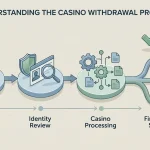
Identity checks can affect when a withdrawal is processed because an operator may need to confirm who holds the account and whether the supplied details match. The documents commonly requested include a photograph of a passport or driving licence and a recent utility bill. Clear images and consistent account details can help avoid requests for clarification, although they do not establish a fixed payment time.
LeoVegas provides a specific example of how these requirements may be applied: its identity check is generally requested at the first withdrawal and calls for photo identification plus proof of address dated within the previous three months. Requirements can differ between operators, so the relevant account terms matter more than assumptions based on another casino’s process.
An additional document review can extend the wait before a withdrawal is approved. A specialist review has reported that first-time withdrawals may incur a further 12–24 hours for document checks. That is a reported estimate, not a universal service standard; the actual timing depends on the operator’s review and whether the submitted material is accepted. A request for another document or a clearer image can add further delay.
Offshore Casinos for UK Players: Licensing and Risks
This practical process offers limited evidence when assessing how trustworthy an online casino may be. Published, specific verification requirements make it possible to understand what may be requested and when. They do not, by themselves, prove that withdrawals will be prompt or that every account will receive identical treatment. Equally, a document request at withdrawal is not necessarily evidence of misconduct: it may be part of the operator’s identity checks.
The useful distinction is between a stated procedure and an outcome. Before relying on a withdrawal estimate, the procedure should be read alongside the operator’s payment terms, including any conditions that could delay approval. Where the requirements are unclear, or a withdrawal remains pending without an explanation, the uncertainty should be treated as unresolved rather than filled with assumptions.
How can I check whether a casino is legal?
Check the UK Gambling Commission’s public register and match the casino’s specific website domain to the responsible licensed business. A brand name alone may not identify the operator.
Is LeoVegas UK licensed?
Yes. The Gambling Commission lists LeoVegas Gaming PLC under account 39198 and identifies leovegas.co.uk as its active UK-facing domain.
What is the fastest withdrawal method?
PayPal is the quickest method listed: withdrawals take roughly 4–6 hours on weekdays and 8–10 hours from Friday to Sunday.
What is the context of GAMSTOP and self-exclusion?
GAMSTOP lets people self-exclude from online gambling, and operators in the UKGC’s Great Britain regime have been required to participate since 31 March 2020. Grace Media was fined £60,000 in June 2025 for breaches involving self-exclusion and direct electronic marketing consent.
Which casino payment methods are generally quickest?
PayPal withdrawals are generally quickest, taking roughly 4–6 hours on weekdays or 8–10 hours from Friday to Sunday. Debit card withdrawals typically take 2–3 banking days after the operator’s review.

Anjouan Casino Licence in the UK: What It Means
An Anjouan licence is issued outside the UK and does not itself show that a...

Foreign Casinos for UK Players: Licensing and Risks
The guide explains what foreign status means in Britain and how licensing, safeguards, payments and...

International Casinos for UK Players: Licensing Explained
An overseas licence alone does not establish permission to serve Great Britain; compare access, safeguards,...

Offshore Casino Sites in the UK: Licensing Explained
The operator’s location is not enough to establish whether its service for British customers is...

Offshore Casinos for UK Players: Licensing and Risks
An offshore operator is defined by accepting British customers without the relevant UKGC licence, not...

British Casinos Not on GamStop: Rules and Risks
GamStop participation follows UKGC licensing, while access, bonus conditions and player safeguards can differ at...

Casino no ID verification in the UK: what it means
An account opened without an immediate document request does not show that age and identity...

Casino Sites Not Registered with GamStop in the UK
GamStop covers UKGC-licensed operators, while sites outside that framework may not be connected to the...

No-ID-Verification Casino Withdrawals in the UK
Learn why “no verification” usually concerns when checks happen, and how licensing, payment methods and...

Non-UK Licence Casinos: How Regulation Works
A licence identifies the jurisdiction associated with an operator, but it does not make the...

UK Casinos Without a UKGC Licence: Rules and Risks
See how UKGC oversight differs from offshore licensing, and what that can mean for legal...

Casinos That Bypass GamStop: Rules and Risks
GamStop applies to participating UKGC-licensed operators, while offshore casinos may sit outside that framework and...

Curacao Casino Licence in the UK: Rules and Limits
A Curaçao licence signals a jurisdictional connection, not UK Gambling Commission supervision or proof of...

Gibraltar Casino Licences in the UK: What They Mean
A Gibraltar connection alone does not establish UK authorisation, customer recourse, responsible-gambling safeguards or data...

Merkur Casino Online UK: Games, Access and Licensing
A brand name alone cannot verify a casino operator, available games or access conditions; those...

No Account Casino UK: How Access Really Works
The label can describe a shorter entry process, but it does not establish what information,...

Non-Gamban Casinos UK: How Coverage and Exclusion Differ
Gamban coverage and GAMSTOP participation are different questions, and neither can be established by the...

Non-GamStop Curaçao casino sites: UK licensing explained
A Curaçao connection does not establish UK authorisation, an operator’s licence status or whether a...

Non-GamStop European Casinos: UK Access Explained
GAMSTOP participation, UK licensing and account exclusions are separate issues, so a European address alone...

Non-UK-Registered Casinos: How Regulation Works
A guide to UKGC oversight, offshore licensing, GamStop access, payments and protections that may not...

Non-UK Regulated Casinos: UK Rules and Licences
The operator’s licence determines whether a casino is regulated by the UKGC, even when the...

Non-UKGC-Licensed Casinos: Rules and Risks
The guide distinguishes UKGC authorisation from offshore licences and outlines differences in player protection, terms,...

Malta MGA-Licensed Online Casinos in the UK
MGA licensing sets requirements such as segregated player funds, while remote gambling in Great Britain...

Online casinos with no sister sites in the UK
A sister-site label may reflect common ownership or shared technology, and those connections do not...

Online Slots Not on GamStop: What the Term Means
GamStop participation concerns the casino offering a game, not the slot’s title, features or developer....

Safe Online Casinos in the UK: Licence and Safety Checks
An overview of licensing, player protections, account checks and payment terms that shape safety in...

Trusted Casinos Not on GamStop UK: What Trust Means
A clear distinction between reputation, overseas licensing claims and the protections attached to UKGC regulation....

Trusted UK Casinos: Licensing and Safety Checks
UK licensing provides a legal threshold, while verification, payment terms, enforcement and crypto claims need...

USA Casinos for UK Players: Licensing and Risks
The guide separates branding from licensing and examines payment, payout and player-protection claims for overseas...

VPN-Friendly Casinos UK: Access and Risks
VPN access may affect location checks and withdrawals, but it does not change a casino’s...