UK Casinos Without a UKGC Licence: Rules and Risks
 Available in GB

See how UKGC oversight differs from offshore licensing, and what that can mean for legal status, payments, complaints and financial risk.
Table of Contents
- What UK Gambling Commission Licensing Means
- How GamStop Fits into the Regulatory Picture
- Anjouan Licensing: Scope and Verification
- The Legal Position for UK Players
- Bonus Terms and the Cost of Play
- Which Jurisdictions Commonly License Non-UK Casinos?
- Offshore Operations and Verification Practices
- Player Protection and Routes for Complaints
- Payment Methods and Withdrawal Timings
What UK Gambling Commission Licensing Means
A non-UK-regulated casino is an online gambling site that operates without oversight from the UK Gambling Commission (UKGC). The distinction is about regulation, not necessarily where a company is incorporated, where its staff work or which countries its website can be viewed from. For customers in Great Britain, the relevant question is whether the operator holds the UKGC licence required to serve that market.
Operators serving customers in Great Britain must hold a UK Gambling Commission licence, regardless of their base of operation. A company does not fall outside this requirement simply because it is established elsewhere. Conversely, an overseas location does not, by itself, establish whether a casino is regulated for British customers. The UKGC’s requirement is tied to supplying gambling services into Great Britain, rather than to the operator’s physical address.
This distinction helps clarify phrases such as “casino without a UK gambling licence”. In ordinary use, the phrase describes a site that lacks UKGC oversight; it does not identify one single alternative regulatory arrangement. A non-UK-licensed casino may be subject to rules in another jurisdiction, or its regulatory status may need separate assessment. What the phrase establishes is only the absence of UKGC regulation. It should not be read as evidence that the site is licensed by another authority, or that any other licence permits it to serve customers in Britain.
For UK readers exploring casinos without a Swedish licence in 2026, payout information is one practical detail to check. This list provides a brief reference point for the stated withdrawal speed.
1. x3bet
Payout speed: 1-3 business days x3bet lists a payout speed of 1–3 business days.
2. NightLuck
Payout speed: 1-3 business days NightLuck lists payouts as taking 1–3 business days.
3. BeOnBet
Payout speed: 1-3 business days BeOnBet gives a stated payout speed of 1–3 business days.
4. WinBeast
Payout speed: 1-3 business days WinBeast lists its payout speed as 1–3 business days.
5. Revery Play
Payout speed: 1-3 business days Revery Play states a payout speed of 1–3 business days.
6. Amunbet
Payout speed: 1-3 business days Amunbet lists payouts within a stated range of 1–3 business days.
7. Zombillion
Payout speed: 1-3 business days Zombillion gives a payout speed of 1–3 business days.
8. Jetsetspins
Payout speed: 1-3 business days Jetsetspins lists 1–3 business days as its payout speed.
9. Dieselwin
Payout speed: 1-3 business days Dieselwin states that payouts take 1–3 business days.
10. NightWin
Payout speed: 1-3 business days NightWin lists a payout speed of 1–3 business days.
The same principle applies to terms such as “international casino” and “foreign casino”. These labels describe an apparent connection to a market or location, but do not answer whether the operator is authorised under the British system. A casino may be based outside the UK and still require a UKGC licence if it serves customers in Great Britain. Equally, a website being accessible from Britain does not demonstrate that it holds that licence. Location and regulatory status are separate matters.
A UKGC licence marks the operator’s place within the British regulatory framework. Without it, an online casino is not under the Commission’s oversight, even if the site offers familiar games or presents itself as a professional service. Similar appearance, branding or game selection cannot establish licensing status. Nor does the use of the word “licensed” on a website, by itself, show that the operator holds the licence required for Great Britain. The relevant distinction is between UKGC oversight and the absence of that oversight.
Safety & Regulation for UK Online Casinos
This is why “online casino without UKGC licence” is not simply another way of saying “casino based abroad”. The first describes the site’s relationship to the British regulator; the second refers to geography. Treating them as interchangeable can obscure the central point: operators serving Great Britain need the relevant UKGC licence whatever their country of establishment. A foreign operator that does not hold it remains outside UKGC regulation in relation to its casino services.
The terms “non-UK-regulated casino” and “non-UKGC-regulated casino” therefore describe a regulatory category, rather than a particular kind of game or payment service. They do not, on their own, reveal which authority, if any, has issued a separate licence. That question is distinct from whether UKGC oversight applies. A site’s claims about regulation in another country cannot be treated as a substitute for a UKGC licence when the operator is serving customers in Great Britain.
The scope of this distinction is Great Britain. The licensing requirement described here applies to operators serving customers in England, Scotland and Wales. It is not a claim that every site with a foreign connection is unlicensed, nor that every site accessible from the country has the same regulatory status. Each case turns on the operator’s licensing position and the market it serves. The basic rule, however, is consistent: service to customers in Great Britain requires a UK Gambling Commission licence, irrespective of where the operator is based.
For that reason, a casino without a UKGC licence should not be described as UK-regulated merely because it accepts customers from Britain or operates in a way that resembles a licensed site. The defining feature is the absence of oversight from the UK Gambling Commission. This regulatory distinction provides the starting point for assessing what kind of framework applies to a non-UK-regulated casino, without assuming that overseas regulation is equivalent to the British system.
Attention: A site’s appearance, branding, or use of the word “licensed” does not prove it holds the specific licence required to serve customers in Great Britain.
How GamStop Fits into the Regulatory Picture
GamStop is the UK Gambling Commission’s self-exclusion scheme. Its reach is defined by the operators that participate in it: casinos outside the scheme are not subject to a GamStop exclusion. This is the central distinction behind the phrase “casino not on GamStop”. It describes a site that does not form part of the scheme, rather than a separate type of gambling product or a different form of self-exclusion.
For someone considering self-exclusion, the boundary matters. A GamStop exclusion does not extend automatically to a non-UK-regulated casino that is outside the scheme. Its existence therefore cannot be treated as evidence that every gambling site accessible online will refuse access. The scheme’s effect is limited to its own participating network; it does not create a universal block across sites operating beyond that network.
This distinction is sometimes obscured by broad labels such as “non-GamStop casinos”. The label can cover sites with different operators and licensing arrangements, but it says only that they are not part of GamStop. It does not establish what other account controls a particular site offers, whether those controls work in the same way, or how effectively an exclusion request is applied. The term is not a substitute for checking the site’s own terms, and it should not be read as an assurance that a site is suitable for someone trying to stop gambling.
Online casinos with no sister sites in the UK
The same point applies to searches for a UK casino site not on GamStop or for non-GamStop casinos aimed at UK players. Such wording does not establish that the site is within the UK self-exclusion framework. In regulatory terms, the relevant question is whether the operator participates in GamStop, not whether a site uses UK-facing language or is accessible from Britain. An accessible site and a site covered by the scheme are not necessarily the same thing.
A reference to a Malta Gaming Authority-licensed or Curaçao-licensed casino does not change that principle. A licence jurisdiction and participation in GamStop are separate matters. The label “MGA casino not on GamStop”, for instance, combines a licensing description with a statement about scheme membership; neither term by itself proves the other. The same applies to a Curaçao casino outside GamStop. These phrases identify possible characteristics, not a guarantee of a particular exclusion process or level of protection.
The practical limitation is important because self-exclusion depends on an operator being within the system that applies it. If a site is outside GamStop, a person who has registered with the scheme should not assume that the registration has closed that account or prevented access there. Nor should the existence of another site-level exclusion option be assumed from the fact that the operator is outside GamStop. Any such option would need to be assessed separately, including how the operator describes its operation and what happens to an account after a request.
This does not mean that GamStop is without a defined purpose. It means that its reach should be understood accurately: it is a UKGC scheme, not a universal restriction on online gambling. A scheme can only enforce exclusion within the arrangements that fall under it. Where an operator is outside those arrangements, GamStop cannot be relied on as the mechanism that restricts access.
Exclusion Risk
A GamStop exclusion does not automatically extend to non-UK-regulated casinos outside the scheme, meaning these sites may not refuse access to registered users.
For the same reason, a list described as the “best non-GamStop casinos” cannot resolve the issue for someone seeking exclusion. Rankings or comparisons do not make a site part of GamStop, and a “best” label says nothing about whether access is blocked for registered users. In this context, those descriptions may conceal the most consequential distinction: the sites being discussed are outside the UK self-exclusion scheme.
Non-UK-regulated casinos also do not provide the UK’s mandatory responsible-gambling tools as a consequence of UKGC oversight. A site may describe its own controls, but those should not be confused with GamStop membership or assumed to have equivalent reach. In particular, no general claim about a site’s deposit limits or self-exclusion arrangements follows from the phrase “not on GamStop”.
The scheme’s boundary is therefore more than a technical detail. It determines where a GamStop exclusion applies and where it cannot be relied upon. For people using self-exclusion to avoid gambling, non-UK-regulated sites outside the scheme remain beyond that specific barrier.
Anjouan Licensing: Scope and Verification
An Anjouan casino licence indicates that an operator claims authorisation under Anjouan’s regulatory framework. It does not establish that the casino is authorised to serve every country. In particular, the licence does not permit operation in the United Kingdom or in other markets identified as restricted. For a service offered to customers in Great Britain, an Anjouan licence cannot replace the required UK Gambling Commission authorisation.
This distinction matters when a casino describes itself as “licensed”. The word alone does not show which regulator issued the licence, which company holds it, or where the operator is permitted to offer gambling. Anjouan authorisation should therefore be read as a jurisdiction-specific credential, not as evidence of UK approval or of permission to operate in any other country.
Curacao Casino Licence in the UK: Rules and Limits
Checking the licence details
A meaningful check involves more than finding an Anjouan badge on a casino website. The public licence register entry, its expiry date and the legal company name should be compared with the details shown in the operator’s terms and conditions. The company named as the licence holder may differ from the brand displayed to customers, so the relationship between the two should be clear. Any mismatch, expired entry or absence of a verifiable register record leaves the claimed authorisation uncertain.
These checks establish only whether the stated licence details appear consistent. They do not show that the operator has a UK Gambling Commission licence, that its services are permitted in Britain, or that its practices meet UK regulatory standards. Nor does a matching entry guarantee that a player will receive a particular level of financial protection or that a complaint will be resolved in their favour.
The scope of the licence should also be considered alongside the operator’s own terms. Anjouan authorisation does not override restrictions on serving particular markets. A site’s availability or acceptance of registrations is not proof that its licence covers the country in which a customer is located.
Complaint handling and dispute resolution
Under Anjouan’s framework, an operator is required to respond to complaints within 30 calendar days. That obligation is not equivalent to an independent decision on the dispute. The Anjouan authority does not receive, mediate or adjudicate individual player complaints, and an Anjouan-licensed casino is not required to provide an independent dispute-resolution route comparable to the services approved under UK regulation.
Verifying Anjouan Licences
Compare Details
Check the public licence register entry, expiry date, and legal company name against the operator’s terms and conditions.
Identify Holder
Verify the relationship between the legal company named as the licence holder and the brand displayed to customers.
Check Consistency
Ensure there are no mismatches, expired entries, or missing records in the verifiable register.
The distinction is between a duty to answer and a mechanism for resolving disagreement. An operator’s response may explain its position, but the framework does not provide the same independent escalation route available through UKGC-approved alternative dispute resolution. Anjouan-licensed casinos are also not required to integrate GamStop. The absence of such requirements is part of the regulatory distinction; it should not be mistaken for evidence that a particular operator has equivalent arrangements of its own.
Testing, audits and player funds
Anjouan’s framework does not require casinos to use RNG testing, undergo audits or keep player funds segregated. This describes what the framework does not mandate; it does not establish that every operator omits every such practice. However, a player cannot infer from the Anjouan licence itself that games have undergone independent testing or that an audit has taken place.
The position on customer balances is consequential. Anjouan authorisation does not guarantee that player funds are held separately from the operator’s business funds. If the operator fails, players are unsecured creditors rather than holders of a guaranteed segregated balance. That status leaves them exposed to the outcome of the operator’s insolvency process, without the protection that segregation would provide.
Accordingly, a licence entry and a company-name match answer a limited question: whether the operator’s stated authorisation can be corroborated. They do not establish UK permission, independent complaint adjudication, mandatory game testing, audited operations or protected customer funds. Anjouan licensing should be assessed within those boundaries, not treated as a general assurance about the service.
Trusted UK Casinos: Licensing and Safety Checks
The Legal Position for UK Players
The legal analysis of a non-UKGC casino involves two separate questions: whether an operator may provide gambling services to people in Great Britain, and whether an individual player commits an offence by using a service based abroad. The Gambling Act 2005 principally addresses the operator’s conduct. It requires a remote gambling business serving the British market to hold a UK Gambling Commission licence, irrespective of where that business is established.
That requirement does not mean that the same legislation makes a player criminally liable merely for placing a bet with an unlicensed site. UK law does not specifically bar British citizens from using gambling services that are licensed in another country, and gambling on a site without a UKGC licence is not, by itself, a criminal offence for the player. The distinction is between the operator’s regulatory obligations and the individual’s position under criminal law; these should not be treated as interchangeable.
This distinction is narrower than a general statement that any overseas service is lawful for UK customers. A licence issued elsewhere does not satisfy the UKGC requirement for an operator supplying services into Great Britain. An operator may therefore hold permission from another jurisdiction while still lacking the authorisation required to serve the British market. The foreign licence and the UK regulatory status answer different questions.
The term “casino not licensed by UKGC” can describe this regulatory position, but it does not determine the player’s legal status on its own. The absence of a UKGC licence is relevant to whether the operator is authorised to serve Great Britain; it does not establish that the player has committed a criminal offence. Equally, the absence of a player offence should not be read as approval of the operator’s activities or as confirmation that the service meets UK requirements.
Legal Distinction
While the Gambling Act 2005 requires operators serving Great Britain to be licensed, using a gambling service based abroad is not, by itself, a criminal offence for the player.
The same distinction applies when a site is licensed overseas. The fact that it has a licence in another country does not convert that licence into UK authorisation. These propositions concern different parties and different legal questions.
The practical position also depends on the relevant part of the UK and the circumstances in which a service is offered. The Gambling Act 2005 governs gambling in England, Wales and Scotland, rather than Northern Ireland.
Anyone considering an overseas gambling service remains responsible for checking the laws relevant to their location and understanding the implications of using a service outside the UK regulatory system. In particular, the fact that a player is not committing a criminal offence does not provide the protections or regulatory standing associated with an operator authorised to serve Great Britain. Legal exposure for the player and compliance obligations for the operator are separate matters.
Bonus Terms and the Cost of Play
A welcome bonus at a casino not on GamStop is not defined by its headline value alone. The wagering requirement determines how much qualifying play is needed before bonus-related funds can be withdrawn, but the calculation base can differ between offers. A requirement may apply to the bonus alone, to the bonus and deposit together, or to the bonus and free spins as a combined amount. The same multiplier can therefore produce different obligations depending on the terms.
A specialist review reports that offshore welcome bonuses can carry wagering requirements of 35x or more. It also describes offers with a 40x requirement, but the amount to which that multiplier applies varies: it may be the bonus, the deposit and bonus, or the bonus and free spins. These reported figures are not a reliable description of every current offer. The specific terms attached to an offer are more informative than a headline multiplier.
How to Assess the Most Trustworthy Online Casinos in the UK
This distinction matters for no-deposit offers as well as deposit-based bonuses. The absence of an initial deposit does not, by itself, establish that winnings can be withdrawn immediately. Conditions may still govern how much must be wagered, which games count, and whether a maximum withdrawal applies. The available offer wording needs to be read as a whole; a short promotional description may not set out every restriction.
Free spins can carry separate conditions. A specialist review reports wagering requirements of 30–50 times the resulting winnings and withdrawal caps of £5–£50. It also reports free-spin packages expiring within 24–72 hours. These are reported examples, not fixed terms across casinos not on GamStop, and they may change between offers. The time limit can affect whether spins are used, while the cap can restrict the amount ultimately withdrawable even after winnings meet a wagering condition.
The order of calculation is consequential. If wagering applies to winnings rather than the original bonus, the qualifying balance changes as play proceeds; if a cap applies, meeting the wagering requirement may still not make the full balance withdrawable. Terms should therefore identify the calculation base, eligible games, contribution rules, expiry, and any withdrawal ceiling. Where those details are unclear, the offer’s practical value cannot be established from its advertised amount.
A pay-and-play label describes a payment process, not necessarily a bonus rule. It does not establish that a welcome offer is available or that a bonus can be combined with a particular deposit method. Those points depend on the individual offer conditions. Comparing the wording of the offer with the account’s transaction terms is necessary to distinguish an advertised incentive from funds that can actually be withdrawn.
Do
- Check the calculation base for wagering requirements
- Identify eligible games and contribution rules
- Review the expiry date and withdrawal ceilings
Don’t
- Rely solely on the headline bonus value
- Assume no-deposit offers allow immediate withdrawals
- Mistake a pay-and-play label for a bonus rule
Which Jurisdictions Commonly License Non-UK Casinos?
Non-UK-regulated casinos may hold licences issued in Malta, Curaçao, Gibraltar or Anjouan. These jurisdictions are among the locations associated with licensing operators that sit outside the UK Gambling Commission’s regulatory system. The list provides geographic context; it does not describe a single, uniform category of licence.
A licensing jurisdiction is the place whose authority issues or oversees an operator’s licence. It does not necessarily identify where the casino’s staff, servers or customers are based. Nor does the name of a jurisdiction alone establish what checks apply to a particular operator. The licence and the company named on it are specific to the individual business.
The four locations should not be treated as interchangeable. They are separate jurisdictions, and a casino’s regulatory status depends on the licence it holds, rather than on a general label such as “international” or “non-UK”. A site may describe itself as licensed abroad, but that description alone does not show which authority issued the licence or whether it is current.
The distinction is relevant to the UK market. A licence issued in one of these jurisdictions is not a UK Gambling Commission licence. The place of licensing therefore gives geographic information, but does not by itself establish that an operator is authorised to serve customers in Great Britain. The regulatory question is separate from the question of where a licence was issued.
Malta, Curaçao, Gibraltar and Anjouan are examples, not an exhaustive catalogue of every jurisdiction that may license non-UK-regulated casinos. Their appearance in the same list should not be read as evidence that their licensing arrangements offer equivalent oversight or protections. Those matters depend on the applicable framework and the particular operator, rather than on geography alone.
Online Slots Not on GamStop: What the Term Means
This distinction also avoids confusing a casino’s licensing location with the legal status of its services in another market. A non-UK casino can be licensed somewhere without holding the UK authorisation required for operators serving Great Britain. Geographic labels are therefore useful for identifying the stated licensing jurisdiction, but they cannot substitute for checking the operator’s regulatory status.
Offshore Operations and Verification Practices
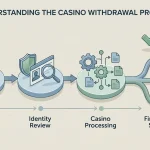
Withdrawal processing at a non-UK-regulated casino can involve more than the time taken by a payment provider. Accounts may be reviewed before a payment is released, and identity checks can become part of that process. This can create uncertainty about when a withdrawal will arrive, particularly where the operator’s procedures are not readily clear.
Published accounts of withdrawal timing conflict. Some describe payments arriving within 24 hours to five business days, while other reporting says withdrawals can take three or four weeks. These accounts should not be combined into a single expected timeframe: they describe materially different experiences. The length of a delay may depend on the operator and the circumstances of an account, but the available figures do not establish a reliable timetable for a particular casino.
Identity checks can also extend the process. A specialist review has reported that some operators may ask for notarised documents or a video call before approving a withdrawal. That is a report about particular cases, not evidence that such requests are standard across non-UK-regulated casinos. Notarisation and live video verification are more demanding than simply submitting identity documents, so their appearance in a withdrawal process is relevant to the practical effort involved.
Withdrawal Delays
Withdrawal timeframes vary significantly, with reported experiences ranging from 24 hours to as long as three or four weeks.
A recently launched casino may have less of an established record against which its procedures can be assessed. The label “new” does not itself indicate how consistently withdrawals are handled or how extensive verification will be. Any stated process should therefore be read as a description of the operator’s terms, not a guarantee that a payment will follow a fixed schedule.
The distinction between a verification request and an unexplained delay matters. A request for further evidence may be presented as part of account checks; repeated or unclear requests can make it difficult to establish what remains outstanding. Where the terms do not explain the steps or timing, there may be limited information available to predict how long resolution will take.
For UK players considering new non-GamStop casinos, operational claims should be treated cautiously. A stated processing estimate does not resolve the disagreement between reported timeframes, and a detailed verification policy cannot ensure that every withdrawal will be straightforward. The evidence supports the possibility of both relatively quick payments and prolonged waits, as well as unusually burdensome checks in some reported cases.
Player Protection and Routes for Complaints
A non-UK-regulated casino may operate under responsible-gambling and data-protection requirements that are less stringent than those applying to a UK Gambling Commission-licensed operator. The exact safeguards depend on the operator and the jurisdiction under which it is licensed; the label “international” does not establish what protections are in place or how they are enforced.
Safe Online Casinos in the UK: Licence and Safety Checks
This difference matters when a player needs to limit gambling, raise a concern about the handling of personal information, or challenge an account decision. Customers of offshore casinos do not have access to the UK’s Financial Ombudsman Service for disputes with those operators, nor to the mandatory responsible-gambling tools required of UK-licensed services. A site may offer its own limits or other controls, but their presence does not make them equivalent to UK requirements.
Complaint routes can also be narrower. A complaint may first have to be made directly to the operator, while recourse to UK regulators is not available for resolving disputes with a non-UK-regulated casino. The existence of a licence elsewhere does not by itself show that a regulator will investigate an individual complaint, mediate between the parties, or provide a route comparable to UK arrangements. The available process therefore needs to be assessed on its own terms, rather than inferred from the fact that a licence is displayed.
This is relevant to claims about the best or newest casinos for UK players. A recent launch or prominent ranking does not establish the quality of safeguards, data handling or complaint procedures. Nor does a polished help centre prove that an independent route exists if an operator’s response is disputed. Promotional descriptions should not be treated as evidence of regulatory protection.
Before relying on any stated safeguard, the operator’s terms and privacy information should be read alongside its complaint procedure. Particular attention should be paid to who receives a complaint, whether an external body can consider it, and what protections apply to personal data. These checks cannot restore access to UK protections, but they can clarify the limits of the operator’s own arrangements. If terms change or a dispute arises, UK regulators and the Financial Ombudsman Service cannot be assumed to provide a remedy.
Regulatory Protection Limits
- Non-UK-regulated casinos lack mandatory UKGC responsible-gambling tools
- Players cannot access the UK’s Financial Ombudsman Service for disputes
- Complaint routes are often limited to the operator without independent mediation
- Data protection and safeguard requirements may be less stringent than UK standards
Payment Methods and Withdrawal Timings
Non-UK regulated casinos may list credit cards, e-wallets, bank transfers and cryptocurrencies as deposit options. Transactions can be routed through alternative processors, so the method shown at the cashier may not identify the company handling the payment. Cryptocurrency can also bypass the UK restriction on gambling deposits funded by credit cards; that does not make the underlying gambling service UK-regulated.
A listed deposit method is not necessarily available for withdrawals. Operators may distinguish between payment routes for money paid in and money paid out, and a supported deposit option does not establish that winnings can be returned through the same channel. The available withdrawal route therefore needs to be understood separately from the deposit menu.
Published timing accounts are not consistent. Some describe withdrawals at Casinos not on GamStop as taking from 24 hours to 5 business days, with the payment method affecting the timeframe. Other accounts report that withdrawals from non-UK regulated casinos can take three or four weeks. These estimates should not be collapsed into a single typical duration: they represent a material disagreement in reported experience, and the timing may depend on the operator and transaction route.
The shorter range is not a guaranteed service standard. A payment provider’s processing time and an operator’s approval process are separate parts of a withdrawal, and an advertised payment method does not by itself confirm when funds will arrive. Where a casino does not provide a clear explanation of its withdrawal routes and processing stages, the payment information offers limited evidence about the likely timing.
These differences matter when comparing payment descriptions with actual withdrawal terms. Card, bank, e-wallet and cryptocurrency support indicates possible transaction methods, not a promise of a particular payout route or speed. A casino’s use of an alternative processor can also mean that the payment provider’s name differs from the casino’s, without changing the need to assess the withdrawal conditions independently.
Casino no ID verification in the UK: what it means
Financial Risks Outside UKGC Regulation
A non-UK-regulated casino may set fewer restrictions on deposits and withdrawals, which can make funds available sooner. That flexibility does not establish that a balance can be withdrawn in full or at the time requested. The operator’s account rules determine how much can be deposited, how withdrawals are processed and whether payouts are subject to limits.
A specialist review has reported that some operators set daily, weekly or monthly withdrawal caps. Where such a cap applies, a large balance may have to be paid in instalments rather than in one transaction. This is a reported feature of particular offers or account terms, not evidence that all non-UK-regulated casinos use the same policy. Limits and conditions can also differ between operators, so a general statement about payout flexibility cannot establish what applies to an individual account.
The distinction between depositing and withdrawing matters. A relatively permissive deposit policy may allow funds to be added without the same constraints found elsewhere, but it does not guarantee equivalent flexibility when money is taken out. A stated withdrawal cap can affect the time needed to receive a larger balance, even where each individual payment is processed promptly. The total exposure may therefore depend on both the operator’s payout rules and the size of the balance.
Before funds are deposited, the written terms should be read for any withdrawal ceiling, the period over which it applies, and whether payments are made in instalments. These details are more informative than a general claim that payouts are fast. Policies may vary and change, so a description in a review should not be treated as a substitute for the terms applying to the account.
The practical risk is not limited to whether a withdrawal is technically available. If a balance exceeds an operator’s cap, access to the full amount may be spread over time. That possibility should be considered alongside any deposit flexibility when assessing the financial exposure of using a casino outside UKGC regulation.
Is it legal for a UK player to gamble at an Anjouan-licensed casino?
UK law does not explicitly prohibit British citizens from using gambling services licensed abroad, and players do not commit a criminal offence by gambling on an unlicensed site. However, operators serving customers in Great Britain must hold a UK Gambling Commission licence.
What payment options are available at non-UK casinos?
They may accept credit cards, e-wallets, bank transfers and cryptocurrencies, sometimes through alternative processors. Some also allow deposits charged to a mobile phone bill or taken from a prepaid balance.
What is the biggest risk of playing at a non-UK-regulated casino?
You may lack important protections if something goes wrong: Anjouan-licensed casinos do not guarantee segregated player funds and do not provide an independent dispute-resolution route comparable to UKGC-approved services. Players also lose access to the UK’s Financial Ombudsman Service and mandatory responsible-gambling tools.
Are gaming sites not on GamStop permitted for UK players?
A site outside GamStop is not covered by that self-exclusion scheme. UK law does not explicitly prohibit players from using services licensed abroad, but operators serving customers in Great Britain are required to hold a UK Gambling Commission licence.
Are Anjouan-licensed casinos safe and fair?
An Anjouan licence does not guarantee fairness or the protection of your funds: the framework does not mandate RNG testing, audits or segregated player funds. The Anjouan authority also does not mediate or adjudicate player complaints.
Are Anjouan casinos connected to the GamStop self-exclusion scheme?
No. Casinos outside GamStop are not part of the scheme, so a GamStop exclusion does not automatically block access to them.

Anjouan Casino Licence in the UK: What It Means
An Anjouan licence is issued outside the UK and does not itself show that a...

Foreign Casinos for UK Players: Licensing and Risks
The guide explains what foreign status means in Britain and how licensing, safeguards, payments and...

International Casinos for UK Players: Licensing Explained
An overseas licence alone does not establish permission to serve Great Britain; compare access, safeguards,...

Offshore Casino Sites in the UK: Licensing Explained
The operator’s location is not enough to establish whether its service for British customers is...

Offshore Casinos for UK Players: Licensing and Risks
An offshore operator is defined by accepting British customers without the relevant UKGC licence, not...

British Casinos Not on GamStop: Rules and Risks
GamStop participation follows UKGC licensing, while access, bonus conditions and player safeguards can differ at...

Casino no ID verification in the UK: what it means
An account opened without an immediate document request does not show that age and identity...

Casino Sites Not Registered with GamStop in the UK
GamStop covers UKGC-licensed operators, while sites outside that framework may not be connected to the...

No-ID-Verification Casino Withdrawals in the UK
Learn why “no verification” usually concerns when checks happen, and how licensing, payment methods and...

Non-UK Licence Casinos: How Regulation Works
A licence identifies the jurisdiction associated with an operator, but it does not make the...

Casinos That Bypass GamStop: Rules and Risks
GamStop applies to participating UKGC-licensed operators, while offshore casinos may sit outside that framework and...

Curacao Casino Licence in the UK: Rules and Limits
A Curaçao licence signals a jurisdictional connection, not UK Gambling Commission supervision or proof of...

Gibraltar Casino Licences in the UK: What They Mean
A Gibraltar connection alone does not establish UK authorisation, customer recourse, responsible-gambling safeguards or data...

Merkur Casino Online UK: Games, Access and Licensing
A brand name alone cannot verify a casino operator, available games or access conditions; those...

How to Assess the Most Trustworthy Online Casinos in the UK
A practical framework for weighing licensing, public evidence, identity checks and gambling controls without treating...

No Account Casino UK: How Access Really Works
The label can describe a shorter entry process, but it does not establish what information,...

Non-Gamban Casinos UK: How Coverage and Exclusion Differ
Gamban coverage and GAMSTOP participation are different questions, and neither can be established by the...

Non-GamStop Curaçao casino sites: UK licensing explained
A Curaçao connection does not establish UK authorisation, an operator’s licence status or whether a...

Non-GamStop European Casinos: UK Access Explained
GAMSTOP participation, UK licensing and account exclusions are separate issues, so a European address alone...

Non-UK-Registered Casinos: How Regulation Works
A guide to UKGC oversight, offshore licensing, GamStop access, payments and protections that may not...

Non-UK Regulated Casinos: UK Rules and Licences
The operator’s licence determines whether a casino is regulated by the UKGC, even when the...

Non-UKGC-Licensed Casinos: Rules and Risks
The guide distinguishes UKGC authorisation from offshore licences and outlines differences in player protection, terms,...

Malta MGA-Licensed Online Casinos in the UK
MGA licensing sets requirements such as segregated player funds, while remote gambling in Great Britain...

Online casinos with no sister sites in the UK
A sister-site label may reflect common ownership or shared technology, and those connections do not...

Online Slots Not on GamStop: What the Term Means
GamStop participation concerns the casino offering a game, not the slot’s title, features or developer....

Safe Online Casinos in the UK: Licence and Safety Checks
An overview of licensing, player protections, account checks and payment terms that shape safety in...

Trusted Casinos Not on GamStop UK: What Trust Means
A clear distinction between reputation, overseas licensing claims and the protections attached to UKGC regulation....

Trusted UK Casinos: Licensing and Safety Checks
UK licensing provides a legal threshold, while verification, payment terms, enforcement and crypto claims need...

USA Casinos for UK Players: Licensing and Risks
The guide separates branding from licensing and examines payment, payout and player-protection claims for overseas...

VPN-Friendly Casinos UK: Access and Risks
VPN access may affect location checks and withdrawals, but it does not change a casino’s...