DelOro payment methods in the UK: GBP, cards, e-wallets and crypto
 Available in GB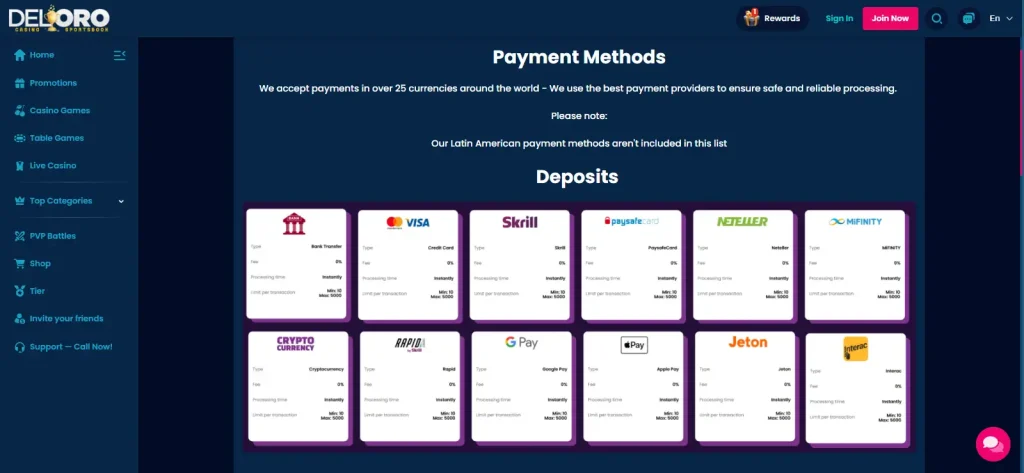
DelOro UK Guide
GBP is listed among DelOro’s supported currencies, and multiple current sources report a broad payment mix covering cards, e-wallets, bank-style transfers and cryptocurrencies. That is the useful high-level answer for a UK reader, but it should not be turned into a guarantee that every globally advertised method will appear in every UK account. DelOro is not being described here as a UKGC-licensed operator, so the cashier must be checked live before depositing. Exact withdrawal times, fees, limits and KYC-dependent payout details belong on the separate DelOro withdrawals page.
Table of Contents
- GBP support is the first practical point for a UK account
- Payment categories reported for DelOro
- Cards require a UK-specific distinction
- E-wallets and digital wallets can add another layer
- Bank-style payments may suit readers who prefer fiat rails
- Crypto broadens the cashier but adds network risk
- How to choose a deposit route rather than just the longest method list
- Payment choices connect directly to account setup and licence context
- A five-step live-cashier check before depositing
- Which DelOro payment route is most practical for a UK account
GBP support is the first practical point for a UK account
GBP support matters because it can reduce the need to hold the casino balance in another fiat currency. If the account is opened in sterling and the chosen payment route also settles in GBP, the player has a clearer view of deposits, wagers and withdrawals without mentally converting every amount. It may also reduce avoidable foreign-exchange friction, although a bank, card issuer, wallet or crypto provider can still apply its own conversion rules outside the casino.
GBP is listed as a supported account currency, and recent independent coverage also includes GBP. That supports a direct statement that sterling is part of the currency set. It does not prove that every payment rail accepts GBP in every session, so the currency shown beside a method in the live cashier is still the operational check that matters.
Payment categories reported for DelOro
Independent sources support four broad DelOro payment groups: card payments, e-wallets or digital wallets, bank-style methods, and cryptocurrencies. That range is more useful than an overlong list of brand names because named processors can be added, removed or restricted by geography. The live cashier determines the actual payment options an account can select.
| Category | What to check in the cashier | Why it matters |
|---|---|---|
| Cards | Whether the card type is accepted, whether it is treated as debit or credit, supported currency and deposit minimum. | Card availability can be affected by issuer rules and gambling restrictions. |
| E-wallets / digital wallets | Displayed wallet brands, funding source restrictions and whether withdrawals return to the same route. | Wallet availability is often account- and region-sensitive. |
| Bank-style methods | Transfer type, currency, beneficiary details and any account-specific instructions. | These routes can differ materially by country and banking network. |
| Cryptocurrency | Supported coin/network, deposit address, confirmation requirements and the exact network selected. | Sending on the wrong network can create an avoidable loss risk. |
The point of this table is not to imply equal availability across all accounts. It is a checklist for reading the cashier. If a method is not displayed after login, a generic review page is not a reason to assume it can still be used.
Cards require a UK-specific distinction
For the Great Britain licensed market, the Gambling Commission’s licence condition prohibits licensed operators from accepting credit-card payments for gambling, including through money-service businesses that would allow the restriction to be bypassed. That is an important piece of UK context, but it must be kept separate from claims about DelOro’s own compliance or cashier configuration.
This guide therefore does not say “DelOro follows the UKGC credit-card ban”. The safer and more accurate approach is to identify the licensed-market rule and then tell the reader to inspect the actual DelOro cashier and their own card type. If a generic source lists “Visa” or “Mastercard”, that alone does not tell you whether a particular debit card, credit card or issuer will work. The distinction should be visible at the point of payment.
E-wallets and digital wallets can add another layer
E-wallets can be convenient because they separate the casino from the primary bank card and may make transaction histories easier to follow. The trade-off is that the wallet has its own rules, verification and funding sources. In the UKGC-licensed market, operators must ensure that e-wallets do not circumvent the credit-card ban, but again that licensed-market rule should not be misrepresented as a verified DelOro control.
When a wallet is displayed at DelOro, check three things before funding it: whether deposits and withdrawals are both supported, whether the wallet balance must come from an eligible funding source, and whether there is any conversion between GBP and another currency. A deposit method that works does not automatically guarantee that the same route will be available for payout.
Bank-style payments may suit readers who prefer fiat rails
Bank transfers and similar bank-linked options are reported as part of DelOro’s wider payment mix. Their practical appeal is familiarity and a direct connection to a bank account, but the exact rail can vary by market. A label such as “bank transfer” can cover different domestic or international processes, so the instructions presented after login matter more than a generic brand list.
For a UK account, verify the beneficiary information, settlement currency and any reference code before sending funds. Do not reuse old bank details from a current view or review because operator banking details can change. If the cashier provides a unique reference, omitting it can make reconciliation harder. These are operational checks rather than claims about DelOro’s payout speed, which is intentionally handled on the withdrawals page.
Crypto broadens the cashier but adds network risk
Cryptocurrencies are repeatedly reported as part of DelOro’s payment offer. That can be attractive to users already comfortable with digital assets, but the payment workflow is less forgiving of mistakes than a typical card deposit. The coin name alone is not enough: the blockchain network, destination address and any required memo or tag must match exactly.
Before sending crypto, copy the current address from the cashier, confirm the selected asset and network, and consider a small test transaction if the method and fees make that practical. Do not rely on an address captured in an old review or current view. Crypto prices can also move between deposit and withdrawal, so a GBP-based player should distinguish the casino balance value from the market value of the asset used to fund it.
How to choose a deposit route rather than just the longest method list
A useful payment decision is based on the route you can actually use, not the number of logos in the cashier. For most UK readers the first filter is currency: if GBP is supported on the account and method, that reduces one source of complexity. The second filter is reversibility and error risk. A bank or card payment has familiar account controls; a crypto transfer requires much more care with destination details. The third filter is withdrawal compatibility, because some operators prioritise returning funds to the original funding route where possible.
It is also worth considering verification. KYC is part of DelOro’s account and withdrawal process, but this page does not publish an exact document list or processing time because those details require current primary evidence. If a payment choice is being made mainly for fast cash-out, read the DelOro withdrawals before depositing so the funding route is not evaluated in isolation.
Payment choices connect directly to account setup and licence context
Payment availability is partly an account question. Registration details, selected currency and verification status can affect what appears later in the cashier, which is why the DelOro registration guide is the natural companion to this page. It explains the account flow without assuming that a payment method seen on one profile must exist on another.
The regulatory distinction also matters. DelOro’s international licensing should not be conflated with a UK Gambling Commission licence. Readers who want the evidence level behind that distinction can use the DelOro licence page. Keeping these topics separate prevents a common review-site mistake: taking a rule that applies to UKGC licensees and silently presenting it as a verified feature of an offshore operator.
A five-step live-cashier check before depositing
- Confirm account currency. Check that GBP is actually selected or displayed where relevant.
- Confirm the exact method. Use only a payment option shown in the logged-in cashier, not one copied from a review.
- Read the transaction details. Check minimums, currency, network or bank instructions presented for that method.
- Check payout compatibility. Find out whether withdrawals can return by the same route or whether another verified method is required.
- Keep a record. Save the transaction reference and current cashier instructions in case support is needed later.
This routine is intentionally method-agnostic. It remains useful even if DelOro changes an e-wallet, banking partner or supported crypto network after this page is published.
Which DelOro payment route is most practical for a UK account
For a UK account, the practical payment route is the one that appears in your live cashier, supports the amount you want to move and has a clear withdrawal path.
GBP support and multiple payment categories are useful, but they do not guarantee every named method for every account.
Check funding and cash-out availability separately before depositing.
Do not infer UKGC consumer protections from payment availability because licensing is a separate decision factor.